
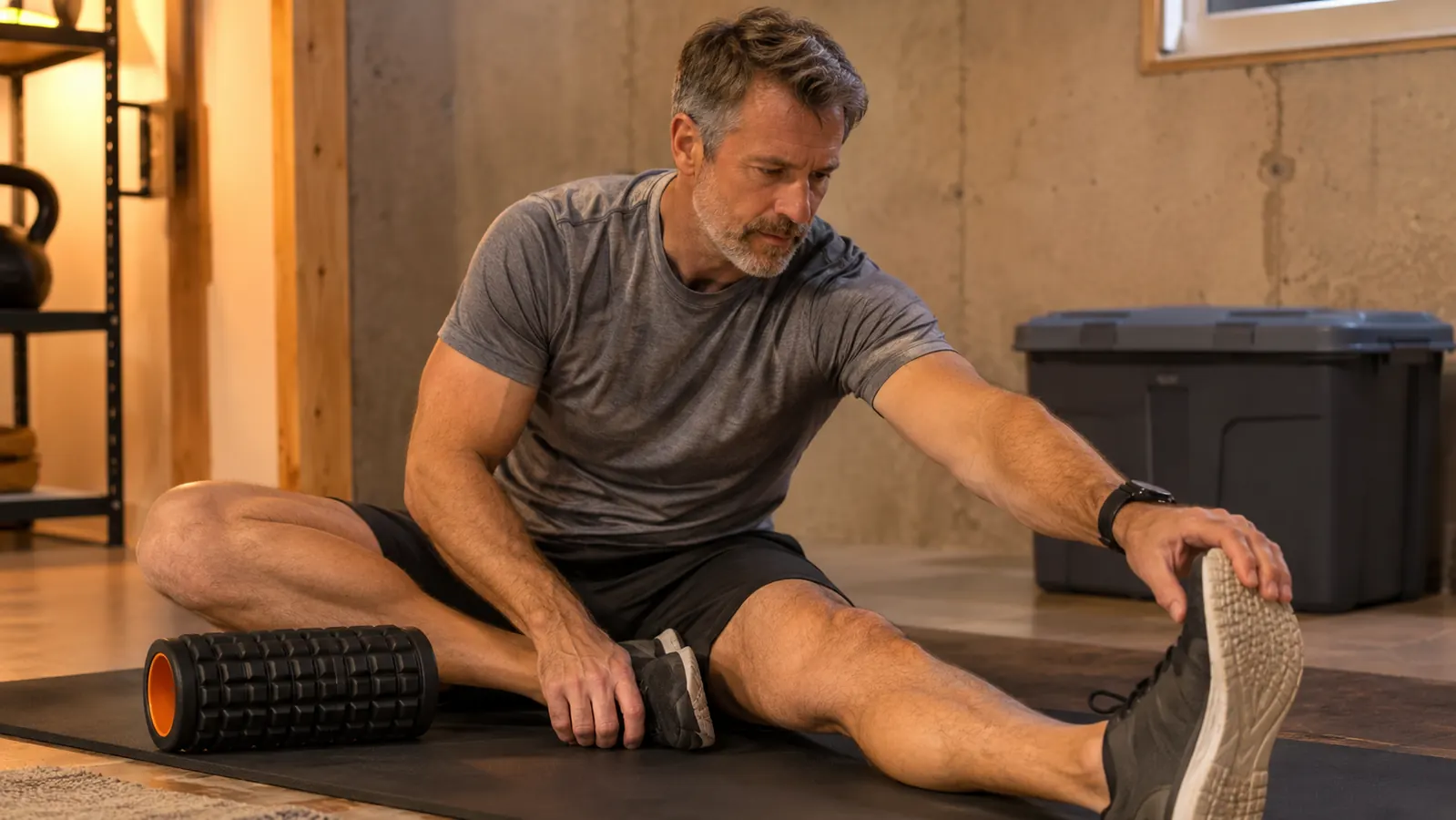
Wednesday night at the Y is the best two hours of my week and the worst two hours for my lower back. I am 49, I play pickup basketball with guys ranging from about 25 to about 60, and I still play like I am 30, which is the entire problem. By the time I get home my calves are tight, my lower back has locked up, and getting out of the car on Thursday morning involves a small amount of negotiating with myself. I am not a doctor, a physical therapist or a trainer. I am a sales manager in Cincinnati with a rubber mat in the basement and one plastic bin of gear.
What changed my Thursday was a birthday gift from my wife Lisa about a year ago, a TOLOCO massage gun. It is rechargeable, it charges off a USB cable, and it came with 10 attachment heads in a case that now lives in that bin next to my foam roller. I had used a friend's percussion gun before and mostly remembered the noise. This one runs on a brushless motor and does not drown out the radio in the basement. More importantly, I found an order to do things in that actually earns the thing its space, and I have run that same order after every Wednesday game for a year. Here it is, start to finish.
The birthday gift that quietly fixed my Thursday mornings
The TOLOCO massage gun. 10 attachment heads, up to 3200 rpm, 12mm amplitude, rechargeable over USB. It has lived in my basement gear bin for a year and it is not going anywhere.
Amazon Check Today's Price on Amazon →One thing up front. None of this is treatment. If something is sharp, swollen, or still hurting a week later, that is a doctor or a PT conversation, not a gadget conversation. What follows is a wind-down routine for a body that got used hard for two hours and needs to come back down. It helps me feel looser and it helps me sleep. That is the entire claim.
Step 1: Walk for five minutes before you sit down
The instinct after a Wednesday game is to collapse into the car, drive home, and go straight to the couch. I did that for years and I think it is a big part of why my back got so stiff. When you stop cold, everything that was warm and loose starts to set up on you. So now I walk. Five minutes, around the block or a couple of laps in the gym hallway while I cool off, before I get in the car. It is not a workout. It is the transition between the game and the rest of the night.
By the time I get home I am still warm but my heart rate is down and I am not going to hurt myself reaching for a water bottle. That is the window where a massage gun actually does something for me. If I wait until I have cooled off completely and my calves have set, it just feels like pressure on cold meat. If I use it in that warm window, I feel the muscle let go. Same device, same setting, completely different result.
The first Wednesday I skipped the walk was last fall, when it was raining sideways and I just wanted to be home. I paid for it on Thursday. My calves were still tight at lunch and I stood at my desk all morning instead of sitting down. Now I walk two laps of the hallway inside the Y when the weather is bad, past the water fountain and back, and that counts as the walk. I also drink a full glass of water before I touch the gun. No science lecture attached. It is just what I do, and it slows me down enough that I do not rush the part that matters.
Step 2: Start with the biggest muscles, on the low setting
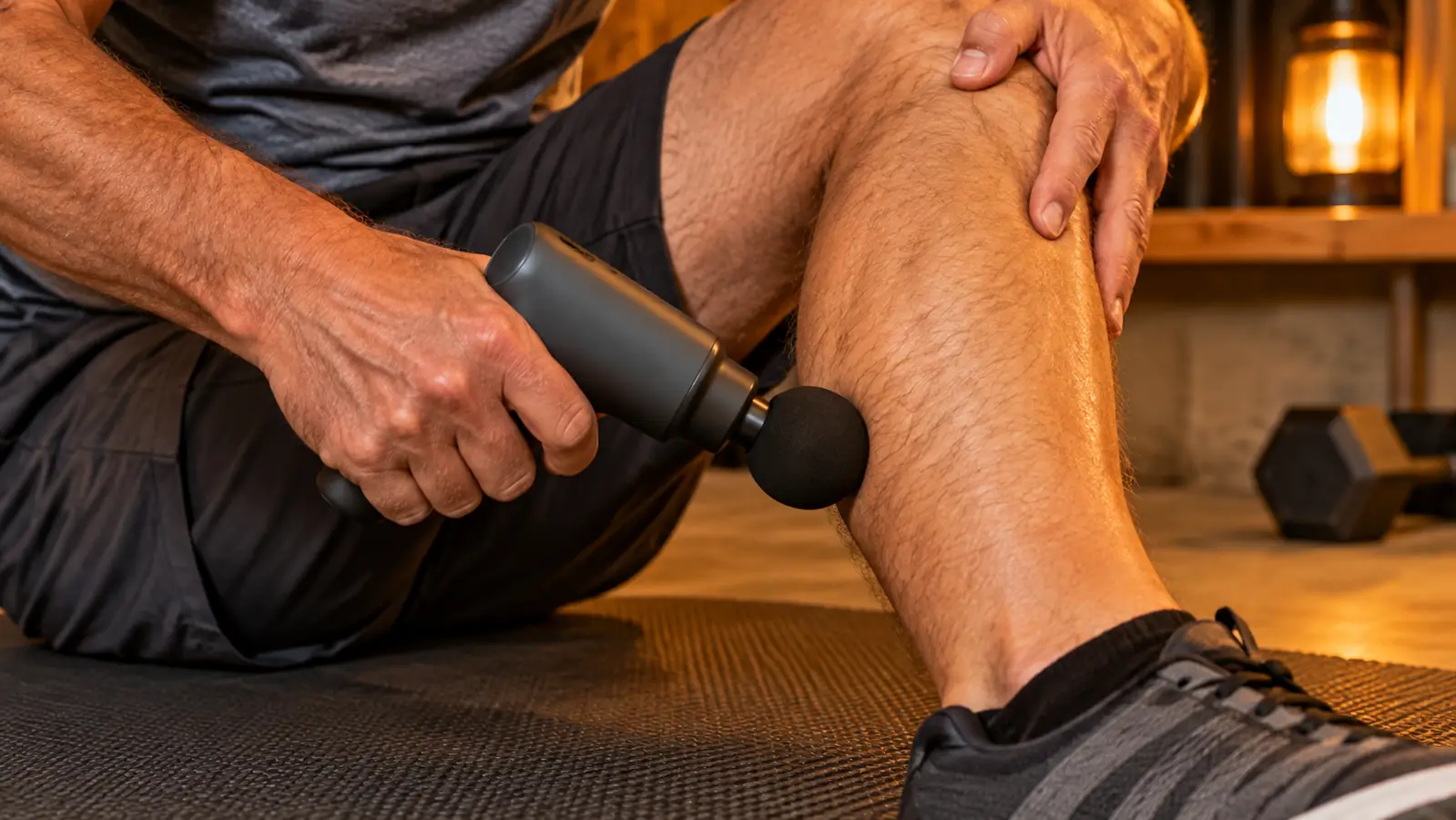
Calves first. Always calves first. I do not know a single person who plays pickup basketball and does not have tight calves, because basketball is basically two hours of small jumps and hard stops. I sit on the mat, put a round head on, and work up and down the back of each calf for about two minutes. Low speed. The gun has speed control and I leave it down near the bottom of the range the entire time.
Then quads, then glutes. Same approach, same low speed, same two minutes per muscle. The glutes get more time than people expect, because that is where my lower back tightness actually starts. When I skip the glutes, my back is stiff on Thursday. When I do not skip the glutes, it usually is not.
Here is the part I had to learn the hard way: low speed and longer time beats high speed and shorter time. I cranked it up the first few weeks because it felt like it was doing more. It was not doing more. It was making me brace against it. I figured this out about three weeks in, after a run of Thursdays where my calves felt buzzy for an hour afterward and no looser. Lisa watched me do it once and asked why I was treating my leg like a nail. She was right. Two minutes on low, moving slowly across the muscle, and I can feel the difference when I stand up.
Of the 10 heads in the case I really only use two. The wide, flat round one for calves, quads and glutes, and a slightly rounded one for the muscles along my back. The pointy ones look great in photos and I have no use for them. The whole gun weighs about two pounds, so holding it one-handed through a two minute pass is not a forearm workout, which matters more at 49 than it would have at 29.
Step 3: Get the lower back right by staying off the spine
My lower back is the reason I started any of this. Long drives make it tight, Wednesday basketball makes it tighter, and my first instinct was to put the gun directly on the spot that hurt. Do not do that. The spine is not a muscle and a percussion device is not a spine tool. The TOLOCO lives in the bin for exactly this job, the lower back and the glutes, and honestly it is the only reason I got consistent about any of it.
What I do instead: wide flat head, and I work the muscles on either side of the spine, never on the spine itself. I sit on the mat with my knees bent, lean back a little, and run the gun up and down the meat beside the bone, about two minutes a side. It is not a dramatic feeling. It is a slow release that I notice when I stand up far more than while I am doing it.
I also do not chase pain. If a spot is genuinely painful rather than tight, I stop and leave it alone. Soreness after a game is one thing. A spot that makes me flinch is a different thing, and it does not get solved by pressing harder with a machine. There was a spot on my right side, maybe a hand's width above my belt line, that got sore after every game for about a month last winter. I kept working it because it kept hurting, which is exactly backwards. It settled down when I stopped fussing with it and started getting more than six hours of sleep.
Two minutes per muscle, low speed, and the gun never touches my spine, my kneecap or my ankle bone. That is the whole protocol, and it is the only version of this I have stuck with for a full year.
Step 4: Leave the joints and the bones alone
I rolled my right ankle badly in a soccer game at 44 and it has never quite been the same. It feels loose on uneven ground. The massage gun does not go anywhere near it. Not the ankle bone, not the tendons behind it, not the spot that aches after a game. That ankle gets a lace-up brace for basketball and soccer and it gets the resistance band work the physical therapist showed me. Percussion on a joint that has already been damaged is not a wind-down, it is a gamble.
Same with the left knee. The soreness I get sits just below the kneecap and it flares when I add running mileage too fast. That is a knee strap for runs and a slower build, not a massage gun target. I work the quad above it and the calf below it and I leave the joint itself alone.
And the neck. I know there are videos. I am not doing it. A friend of mine is a nurse and she gave me one look when I brought it up, and that was the end of that idea.
Step 5: Finish with a stretch, then put the gear away
The gun is the middle of the routine, not the end of it. After the big muscles I spend another five or six minutes stretching on the mat. A calf stretch against the basement wall, a hip flexor stretch, a slow seated reach. Nothing impressive and nothing you would film. The point is that the gun gets things moving and the stretch uses that window before it closes.
Twice a week, usually Tuesday and Saturday, I do a short session with resistance bands instead. Lateral band walks, glute bridges, ankle work with the band around my foot. Those are the exercises the physical therapist gave me after the ankle sprain five years ago, and I let them slide for years before I got serious about them again about eighteen months ago. I started with the lightest band in the set, the yellow one, and it was humbling. Lateral walks across the width of the mat, ten steps each way, and my hip was burning by the third pass. Eighteen months later I use the next one up for the walks and still use the light band for ankle work. It takes ten minutes and I have never once looked forward to it.
Then everything goes back in the plastic bin in the corner of the basement and I go upstairs and go to bed. That last part matters more than people give it credit for. A routine you actually put away is a routine you will actually do again next Wednesday.
What Else Helps
Three things I would add if you are starting from zero. First, a foam roller, used on the nights you are not using the gun. I roll my calves, quads, the outside of my thighs and my upper back on Sunday nights after soccer, never directly on my lower spine. Mine is a smooth one, dense and still holding its shape after three years, and that is all I need it to do.
Second, sleep and water. It sounds like a cop-out answer and it is not. The weeks I sleep badly are the weeks my back is stiff no matter what I do on the mat. Third, be honest about what a wind-down routine is for. It helps me feel looser and come back more comfortably. It does not fix a joint and it does not replace a PT. If something is still hurting a week later, or it wakes you up at night, that is a call to your doctor, not another ten minutes in the basement.
I am 49 and I would like to still be playing Wednesday nights when I am 59. The routine is boring, it takes about twenty minutes, and it is the reason I am not limping on Thursdays. That is the whole pitch.
Twenty minutes on Wednesday buys you a normal Thursday
The TOLOCO massage gun. 10 attachment heads, speed control, USB rechargeable, about two pounds, and small enough to live in a plastic bin in the basement. If your current postgame routine is sit on the couch and hope, this is a reasonable place to start.
Amazon Check Today's Price on Amazon →