
The sore spot showed up in February, right below my left kneecap, and it had a personality. It was quiet on the first mile, loud on the third, and it stuck around for an hour after I got home and sat down with coffee. I did what most 49-year-olds do: I ignored it for three weeks, then I got worried, then I bought something off Amazon at 11 p.m.
That something was the Bodyprox Patella Tendon Knee Strap, a two pack, about eight months ago now. I have run through it, walked around in it, washed it in the sink more times than I can count, and lost the second strap of the pair somewhere in the plastic bin in my basement. This is not a medical writeup. I am a sales manager in Cincinnati who plays Sunday rec-league soccer and runs three mornings a week, and this is what eight months of actual use looked like.
The Quick Verdict
A cheap, simple strap that gives me a consistent, mild sense of pressure just below the kneecap on runs. It did not fix my knee. It did make the third mile less of a negotiation, and that was enough for me to keep it.
Amazon Check Today's Price →If the spot below your kneecap has opinions about mile three, this is the strap I've been running in since spring.
Bodyprox Patella Tendon Knee Strap, two pack. One size, hook and loop, adjustable. I wear one on the left knee, about two fingers below the kneecap, and keep the other as a spare.
Amazon Check Today's Price on Amazon →How I've Used It
I bought the two pack in the spring, when the soreness below the left kneecap flared up as I was building mileage back after a lazy winter. My pattern is three runs a week, mostly three to five miles on the roads around my neighborhood and a park loop that has one long, gentle downhill that I have come to hate. I also play Sunday morning soccer and pickup basketball at the Y on Wednesday nights.
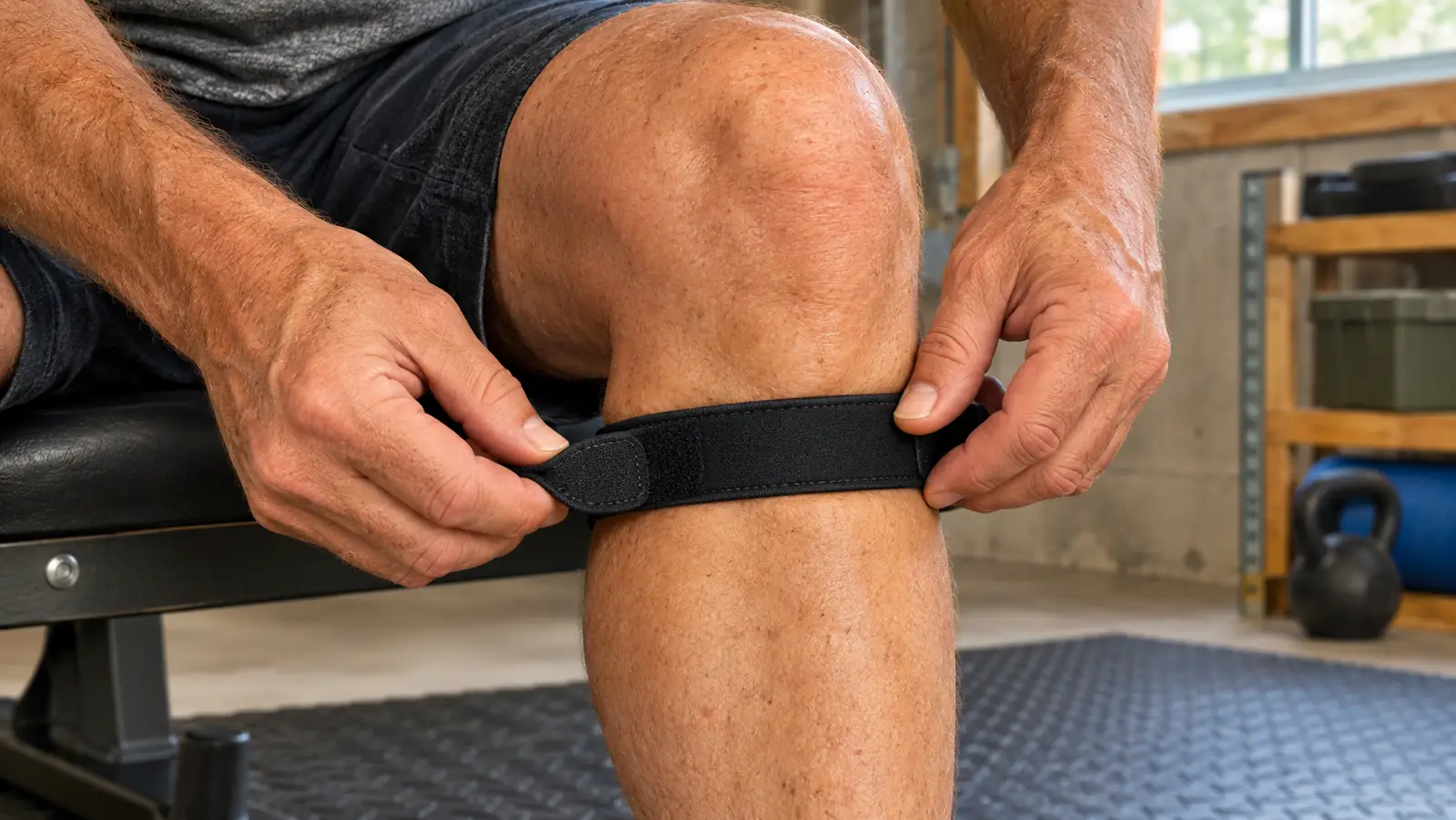
The strap goes on the left knee only, positioned just below the kneecap, over the top of my running tights or bare skin depending on the weather. It has a hook and loop closure and one size, so there is no sizing decision to make. My routine is the same every time: strap on in the driveway, adjust it once more about a quarter mile in, and then leave it alone.
Here is what a normal Tuesday looks like. Alarm at 5:40, coffee, out the door by 6:05 while it is still gray and the streetlights are just going off. I sit on the tailgate of the truck, roll the left leg of my tights up to just below the knee, and set the strap two fingers down from the kneecap. Then I stand up, bend the knee twice, and adjust it once more, because standing changes where it sits by a good half inch. The first quarter mile is always a negotiation. By the time I reach the stop sign at the end of my street it has settled, and I do not think about it again until I am peeling it off in the driveway forty minutes later.
The second strap of the pack has stayed in the plastic gear bin in the corner of my basement, along with my foam roller and resistance bands, as a spare. I have not needed the spare. After eight months of three runs a week, plus a couple of washings a month in the sink, the first one still closes cleanly and the edges have not frayed. The listing says hand wash only, and I have followed that, mostly because the one time I forgot and threw it in with towels I spent ten minutes picking lint off the gel pad.
What the Strap Actually Is
Strip away the marketing language and the Bodyprox strap is a narrow band that wraps around the leg just below the kneecap and closes with hook and loop. It has a built-in silicone gel pad that sits against the skin under the kneecap. The materials are listed as nylon, SBR, spandex and a bit of cotton, it weighs 3.2 ounces, and it is listed at 0.1 centimeters thick, which is the part I care about most. It disappears under tights. I have worn it under jeans to the grocery store after a run and forgotten it was there.
One thing it is not: it is not a sleeve. There is no fabric tube over the whole knee, no hinges on the sides, no straps running up the thigh. It is one narrow band, it covers maybe two inches of leg, and when you take it off there is a faint line of pressure where it sat. For me that was the appeal. I wanted something I could ball up and drop in a jacket pocket, not a piece of equipment I had to plan a run around. The silicone gel pad is the only part that presses on the sore spot, and it is small, roughly the width of a thumb, which is why placement matters more than how hard you crank it down.
The adjustment range is the whole trick. You do not want it tight enough to feel your pulse in your shin, and you do not want it so loose that it slides down toward your calf on the first hill. I landed on snug enough that I can still slide a finger under the edge, and I check it once mid-run on longer days.
One thing worth being clear about: the strap does not sit on the kneecap itself. If you put it directly over the kneecap, it will feel wrong within a hundred yards and it will migrate. Below the kneecap, on the soft spot, is where it does whatever it does for me.
The First Two Weeks
Honestly, the first week I thought I had wasted my money. The strap felt like a piece of hardware strapped to my leg, and I was aware of it on every step. I also had it too high the first two runs, basically on the kneecap, which is not the fault of the strap. Once I dropped it down and loosened it a notch, the awareness faded to background noise by the end of the second week.
I remember the first run specifically because it was the first Saturday in March, a 3.4 mile loop around the park with the downhill right at the halfway point. I had the strap too high, sitting on the kneecap, and by the bottom of the hill it had slid up and I was stopped in the middle of the path fixing it like a guy adjusting a backpack. Second run, same thing, only worse, because I had overcorrected and cranked it down, and my calf was buzzing by mile two. Third run I moved it two fingers down, loosened it, and that was the version I have used ever since. Two bad runs is a fair price for learning where the thing goes.
The other thing that happened in those two weeks: my knee did not magically stop being sore. I want to be careful here because I am not qualified to tell you what is going on inside your knee and neither is a product page. What changed for me was the character of the soreness. Instead of the sharp little complaint on the downhill, I got a dull awareness that faded by mile four. I finished runs feeling like I had run them, not like I had been in a fight with them.
That was the whole return I got, and it was enough for me to keep wearing it three mornings a week for eight months.
Where It Helped and Where It Didn't
The strap helps most on consecutive running days. When I run Monday, Wednesday and Friday, the Friday run used to be the one where the sore spot made decisions for me. With the strap, Friday feels like Wednesday. On the long park loop with the downhill, it takes the edge off in a way I can feel but cannot really explain.
The clearest test was a week in June when I got greedy. I had been running three miles three times a week for a month, feeling good, and I added a fourth run and pushed the Friday one out to five miles. By that Sunday my knee was talking again, and the strap did not save me from it. It was still helpful during the runs themselves, but the soreness came back between runs, which is the signal that I had done too much too soon. I dropped back to three and it settled in about ten days. Same lesson as every other time. The strap is not a mileage license.
Where it did nothing: soccer. I tried it under my socks on a Sunday once. Between the strap, the shin guard and the sock, my lower leg felt like a packed suitcase, and the strap slid out of place within ten minutes of running. It is not built for that. It is a running strap. I have also not used it for basketball, because the Wednesday night game is where my right ankle brace earns its keep and I did not want to layer gear I was still learning to trust.
It also did nothing for the actual cause of my problem, which was adding mileage too fast. The strap made the runs tolerable. Cutting back to three miles for two weeks is what made the soreness settle. I did those two things at the same time, and I cannot untangle which one did the work. I suspect it was both, and I suspect the mileage cut mattered more.
The strap made the runs tolerable. Cutting back to three miles for two weeks is what made the soreness settle. I did both at once, and I am not going to pretend I know which one did the work.
Durability and the Annoyances
Eight months in, three runs a week, hand washed twice a month: the closure still grabs, the stitching is intact, and the gel pad has not cracked or separated from the fabric. For 3.2 ounces of nylon and spandex, it has held up better than I expected. I have had socks fall apart faster.
The annoyances are small but real. It collects sweat and needs washing more often than you would think, and hand wash only is genuinely inconvenient when you are standing at a basement sink at 9 p.m. because you want it for the morning. The edges curl a little after repeated washing, and I have had to press them flat against the leg before closing the strap so the hook side lands where it should.
And the second strap. I know the two pack is a value thing, but it meant I had to find a place to keep a spare I never needed, which in my house means it went into the plastic bin and became part of the general archaeology down there. If I were buying again I would probably still get the two pack, because the difference is small, but the one I use is the one that matters.
What I Liked
- Mild, consistent pressure below the kneecap that I can feel on the third mile
- Thin enough at 0.1 centimeters to wear under tights without noticing it
- Adjustable hook and loop closure stays put on road runs
- Held up over eight months and roughly a hundred runs, hand washed
- Two pack means a spare for the gear bin
Where It Falls Short
- Slides out of place under soccer socks and shin guards, not built for that
- Hand wash only, which is a nuisance mid-week
- Edges curl slightly after repeated washing
- Does nothing about the cause of the soreness, only the discomfort during runs
- Silicone pad collects lint if you machine wash it by accident
Who This Is For
If you are a runner with a sore spot just below the kneecap that shows up when you build mileage, and you have already tried backing off and it is not enough on its own, this is a reasonable, cheap thing to try. It is also a good fit if you want something thin enough to wear under normal clothes, or if you are the kind of person who wants a simple piece of gear with one adjustment instead of a sleeve with five panels and a diagram.
It is a good fit for the runner who is already doing the boring work, the warm-up and the hip and ankle exercises and the cutback weeks, and wants a little help getting through the middle miles while the rest of it takes effect. That is where I landed, and eight months later it is still in the rotation.
Who Should Skip It
Skip it if the soreness is sharp, if it wakes you up at night, if there is swelling, or if the knee gives way. That is not a strap conversation, that is a doctor or a physical therapist conversation. I have been to a PT exactly once in my life, after I rolled my right ankle badly five years ago, and I should probably have gone back for the knee instead of buying something on Amazon at 11 p.m. That is the honest version.
Also skip it if you want it for soccer or basketball. It is not going to survive under a sock and a shin guard, and there are other products for that. And skip it if you are expecting the strap alone to solve the problem. It manages discomfort during runs. It does not fix the reason you have it. If you are not willing to cut mileage or do the warm-up, you are buying a bandage, not a fix.
Eight months, one hundred runs, one strap that still closes. If that is the kind of gear you're after, here it is.
Bodyprox Patella Tendon Knee Strap, two pack, one size, hook and loop. Talk to your doctor or a PT about the soreness itself. Then decide if you want a strap for the miles in the meantime.
Amazon Check Today's Price on Amazon →