
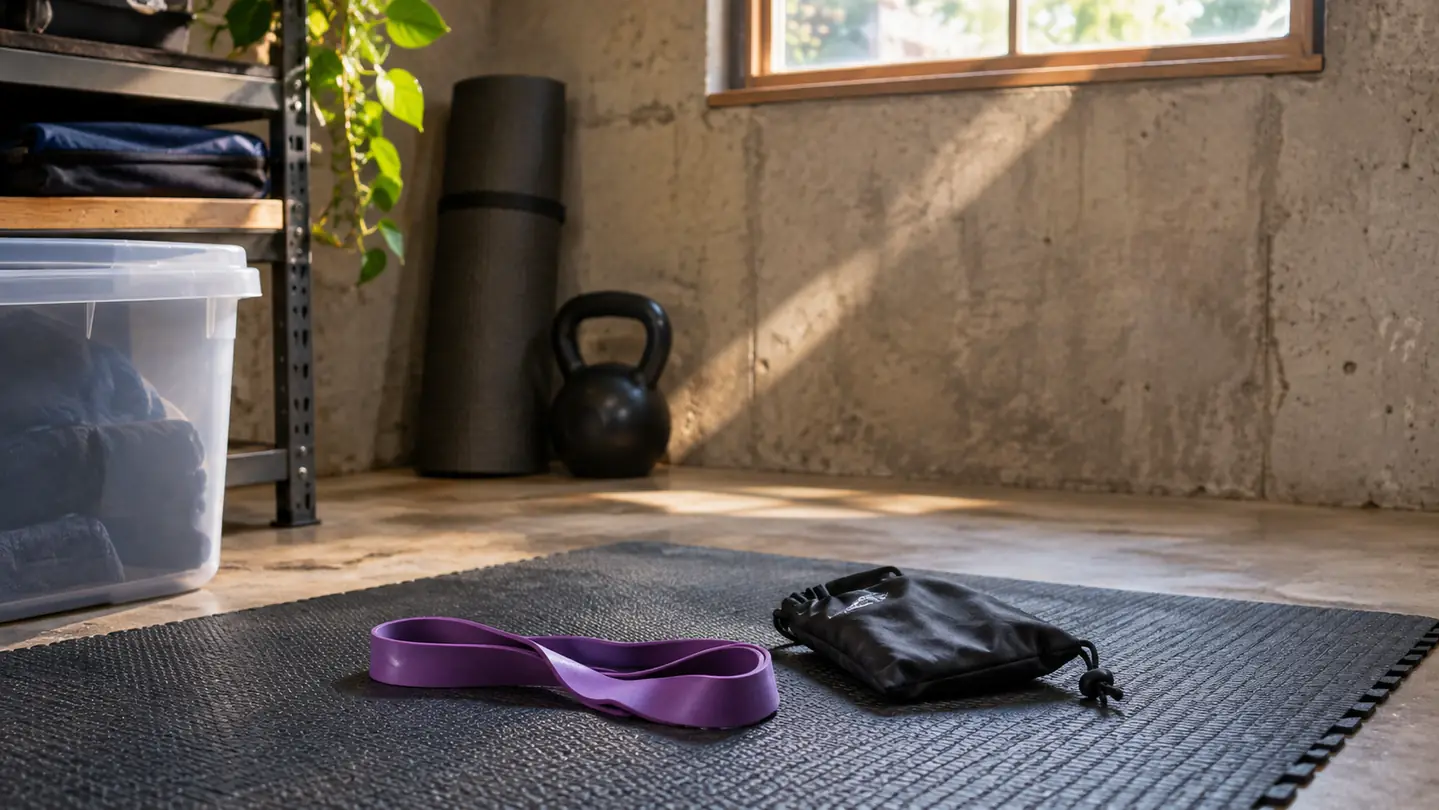
The physical therapist gave me four exercises after I rolled my right ankle in a Sunday rec-league soccer game five years ago. Lateral band walks. Glute bridges. Ankle range work. Something standing with a loop around my thighs that I still cannot do without my hip hiking up. I did them for three weeks, felt better, and quit. That is the whole story of my right ankle since.
Four years later I was online at 11 pm on a Tuesday buying a set of Fit Simplify Resistance Loop Bands, mostly because my ankle had started complaining again on uneven ground and partly because I had run out of excuses that held up. A year and a half in, these are the one piece of recovery gear in my basement bin that gets used every single week. Not because they are interesting. Because they take ten minutes, they live downstairs, and my ankle behaves better when I use them.
The Quick Verdict
Five flat latex loops, five tensions, one small bag. They do the boring prehab work that keeps my ankle and knee from flaring up, and they have held together for eighteen months of twice-weekly use. Not a gym replacement, and the lightest band will feel like nothing if you are already strong.
Amazon Check Today's Price →The piece of recovery gear I use most is the one that costs the least
Five latex loops, a carry bag and an illustrated guide. Mine live in a plastic bin next to a rubber mat and get used twice a week, every week, for eighteen months and counting.
Amazon Check Today's Price on Amazon →How I've Used It
The routine is not impressive. Twice a week on a rubber mat in the corner of the basement, about ten minutes, plus a shorter version in the parking lot at the field on Sunday mornings before soccer. The carry bag lives in my soccer duffel now. It has spent a winter in the trunk of my car and it still zips.
The first four months I missed three sessions. The fifth month I missed all of them, no injury, just life, and the soreness below my left kneecap came back inside three weeks.
I tried a cheaper route first. For about two months I used a length of surgical tubing I had in the garage, tied in a loop, and it was a mess. The knot sat right where the band crossed my thigh and dug in on every step, and when the tubing finally split it split at the knot, which is exactly where you would expect. Before that I had tried an old bike inner tube, which is even worse because it rolls into a rope the moment you load it. The flat latex loop solves both problems at once, which is the whole reason I stopped improvising.
The set is five latex loops in five tensions. I use three of them. The lightest one is for ankle work, the middle one for glute bridges and lateral walks, and the heaviest for a standing hip abduction exercise that humbles me every single time. The two in between mostly sit in the bag. That is not a knock on the product. That is how sets work.
What matters to me is whether a band stays where I put it. A loop that rolls down your thighs mid-set is worse than no band at all, because you stop to fix it and then you stop doing the exercise. These are flat latex, 12 inches long by 3 inches wide and a quarter inch thick, and on bare skin or over shorts they mostly stay put. On heavy lateral walks the thickest one will still creep up. Every band I have owned does that.
On running mornings the bands do a different job. Two sets of lateral walks and a set of glute bridges before I head out, and the soreness below my left kneecap is quieter on those runs than on the ones where I skip it. I still wear the patella strap on the left knee for anything over three miles. The band work did not replace the strap. It just made the first mile less of a negotiation.
The other thing I noticed is that I stopped bargaining with myself. When the ankle exercises required driving to the Y, they got skipped roughly half the time. When they require walking downstairs in socks, they get done. That sounds like a small thing. Over eighteen months it is the difference between a routine and a memory of a routine.
What's Actually in the Set
Five latex loops, a small drawstring carry bag, and an illustrated instruction booklet. The booklet covers dozens of exercises, which sounds like the filler that comes in the box until you are standing in a cold basement at 6:10 in the morning trying to remember what somebody told you five years ago. I used it for the first month. Then I wrote my four exercises on an index card and taped it to the wall, because I am 49 and I need a card.
After a month I got curious and laid all five out on the mat to compare them. Laid flat and unloaded they look nearly identical, all 12 inches long and 3 inches wide, and the only way to tell them apart is to grab one and pull. That is mildly annoying when you are standing in a cold basement in socks. I fixed it by keeping them in the same order in the bag, lightest on the left, and I have not mixed them up since.
The bands are latex, so if you have a latex allergy this is not your set and you probably already know that. The whole set weighs 3.5 ounces, less than a water bottle. The listing calls them heavy duty. I would describe them as well made and honest about what they are: flat loops, not tubes, not fabric covered, not a cable stack.
The five tensions are named, not numbered. Extra light and light are genuinely light. If you have never used a loop band, the light one will feel like you are doing nothing for the first two sets and then your hips will file a complaint the next morning. The heaviest band is not a substitute for a cable machine and it is not pretending to be. Fit Simplify sells a simple thing here, and the simplicity is the reason it actually gets used.
The Sunday Morning Warm-Up
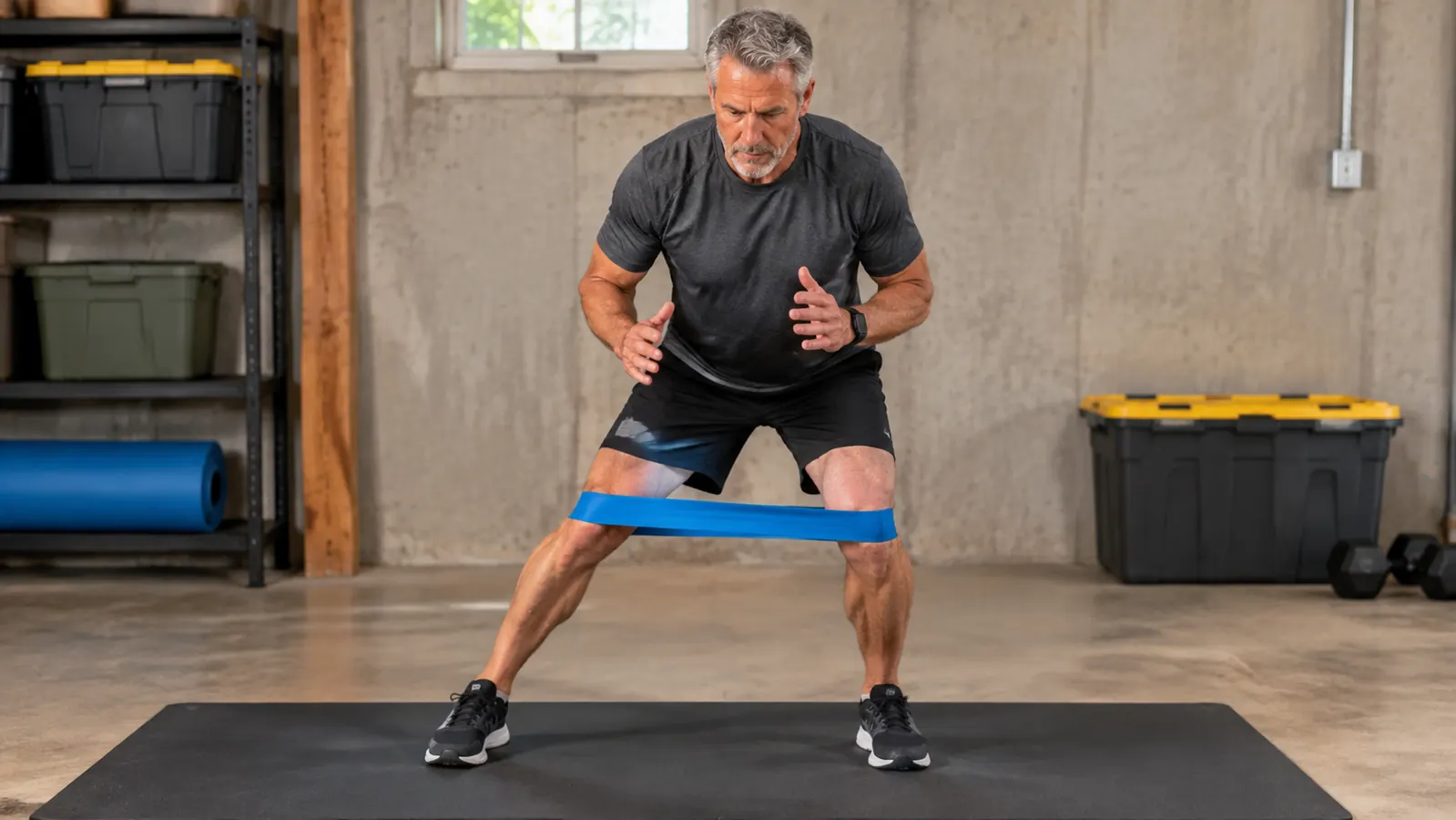
This is the part that changed my Sundays. I get to the field about fifteen minutes early, pull the bag out of the duffel, and do three things. Twenty lateral band walks in each direction with the loop just above my knees. Fifteen glute bridges with the loop in the same spot. Then a couple of minutes of ankle work with the light band looped around the ball of my foot.
One morning last October it was 38 degrees at the field with frost still on the far touchline, and that is the day the warm-up stopped being optional for me. I had skipped it because we were short-handed and I was late, and my first sprint in the first five minutes felt like my right ankle was made of loose parts. Nothing happened. Nothing rolled. But I spent the rest of the half thinking about it instead of about the game, and that is its own kind of cost.
I started this after the ankle rolled over again on a bumpy field two seasons ago, which is also when I bought the lace-up brace I now wear on Sundays and Wednesdays. The brace still goes on. I am not giving that up. But the warm-up is the part that makes me feel like I am doing something rather than hoping.
Does it work? I do not have a controlled study and I am not going to pretend I do. I can tell you I have played two full seasons since I started doing it and I have not rolled the ankle again. I can tell you my first three steps on a cold morning feel less like a question mark. I can also tell you that the weeks I skip the warm-up are the weeks my hip tightens up after the game. Do with that what you will. If you have a real problem, talk to your doctor or a PT, not to a guy on the internet with a plastic bin.
The twice-a-week home session is the same idea with more of the hip work in it. Heaviest band above the knees, side steps until the outside of my hip starts talking, then bridges, then the ankle stuff. Ten minutes. I do it Sunday night after I get home and Wednesday morning before work. It is not training. It is maintenance, the same way I change the oil in the car.
Eighteen Months Later: What Held Up
I bought the set a year and a half ago. No band has torn. None has gone baggy in a way I can measure, because I have not bought a second set to compare against. The light band has a scuff where I loop it around a basement support post for rows, and the scuff has not turned into a crack. I have snapped cheap bands before and the failure always starts at a nick on the edge and runs from there. Nothing has run.
I checked them over properly in the spring, the way I check my boots before a season. I held each band up to the basement light and pulled it out to about double its resting length, looking for a thin spot or a nick at the edge. The light band has that scuff from the post. The middle band has a faint crease where it lives folded in the bag. Neither one spread over the summer, and I stopped worrying about it.
The bag is the weakest component and it is still fine. It is a plain drawstring pouch. It has been sat on inside a duffel, dragged across parking lot grass, and rained on once. I would not call it rugged. I would call it adequate, which is a different word with a different meaning.
The set has also been on two road trips and a week at a rental cabin in Tennessee. The bag went into the suitcase and the bands came out on the porch. I cannot say that about the foam roller.
The instruction booklet has a coffee ring on it now. That is the most honest durability test I can offer.
When the ankle exercises required driving to the Y, they got skipped half the time. When they require walking downstairs in socks, they get done.
What They Won't Fix
A band is a piece of elastic. It loads tissue in a direction, and that is the entire mechanism. It does not know which direction you need, how much, or how often. The instruction booklet is a reasonable starting point and it is not a substitute for twenty minutes with somebody who knows what your ankle has been through.
They also do not replace weight. If your goal is a heavier squat or a bigger deadlift, you will outgrow these in a few weeks and you should buy long power bands or use the cable stack. The heaviest loop in this set is a warm-up tool for a strong lifter. I am not a strong lifter, so that has not been my problem, but I have watched plenty of guys in the weight room at the Y make exactly that mistake.
And the rolling is real, whatever the product page implies. On heavy lateral walks the band creeps up your thighs. Shorts with a grippy hem help. Bare skin helps. Nothing eliminates it. You learn to set your feet, take your steps, reset once, and get on with the set instead of fighting the band.
What I Liked
- Five tensions cover ankle work, glute work and hip work without buying three separate products
- Flat latex loops stay in place better than the tubular bands I have used
- The carry bag earns its spot in a soccer duffel and has survived a full year of Sundays
- The illustrated booklet was more useful than expected for rebuilding a routine from memory
- 3.5 ounces for the whole set, so there is no excuse to leave them at home
Where It Falls Short
- Three of the five tensions do the real work, the middle two mostly sit in the bag
- The heaviest band still rolls up the thigh on heavy lateral walks
- Latex, so it is off the table entirely if you have a latex allergy
- Not a substitute for weights once you get stronger
- Levels are named rather than measured, so progress is tracked by reps and feel
Who This Is For
Weekend athletes with a cranky joint and a list of exercises they were handed once and slowly stopped doing. That was my situation exactly and the Fit Simplify set fits it. If you need light resistance for ankles, hips and glutes in ten minute blocks, at home or in a parking lot, this is the set I would hand you.
It is also a decent first purchase for someone building back into running or a court sport who has no equipment and no interest in a gym membership. Ten minutes of lateral walks and glute bridges before a run is the part of my routine I would keep if I had to drop everything else, and I say that as a guy who also owns a foam roller and a massage gun and would miss both of them.
Who Should Skip It
If you already train with a barbell, buy long power bands or use the cable stack. These will feel like a toy to you and you will be right. If you have a latex allergy, skip. If you want a program built around your specific injury, this is not that, and no box of bands is.
And if a joint has been sore for months, a set of elastic loops is not the answer. I did the exercises the physical therapist gave me for three weeks after my ankle sprain and then let them slide for four years, which is a different flavor of the same mistake as never going at all. Bands are a tool. Somebody who knows what they are looking at tells you how to use it. Talk to your doctor or a PT.
Ten minutes in socks, twice a week, is the whole program
Five latex loops, a carry bag and an illustrated guide. Mine have been in the rotation for eighteen months and they are the one piece of gear in my basement I would replace the same day it broke.
Amazon Check Today's Price on Amazon →