
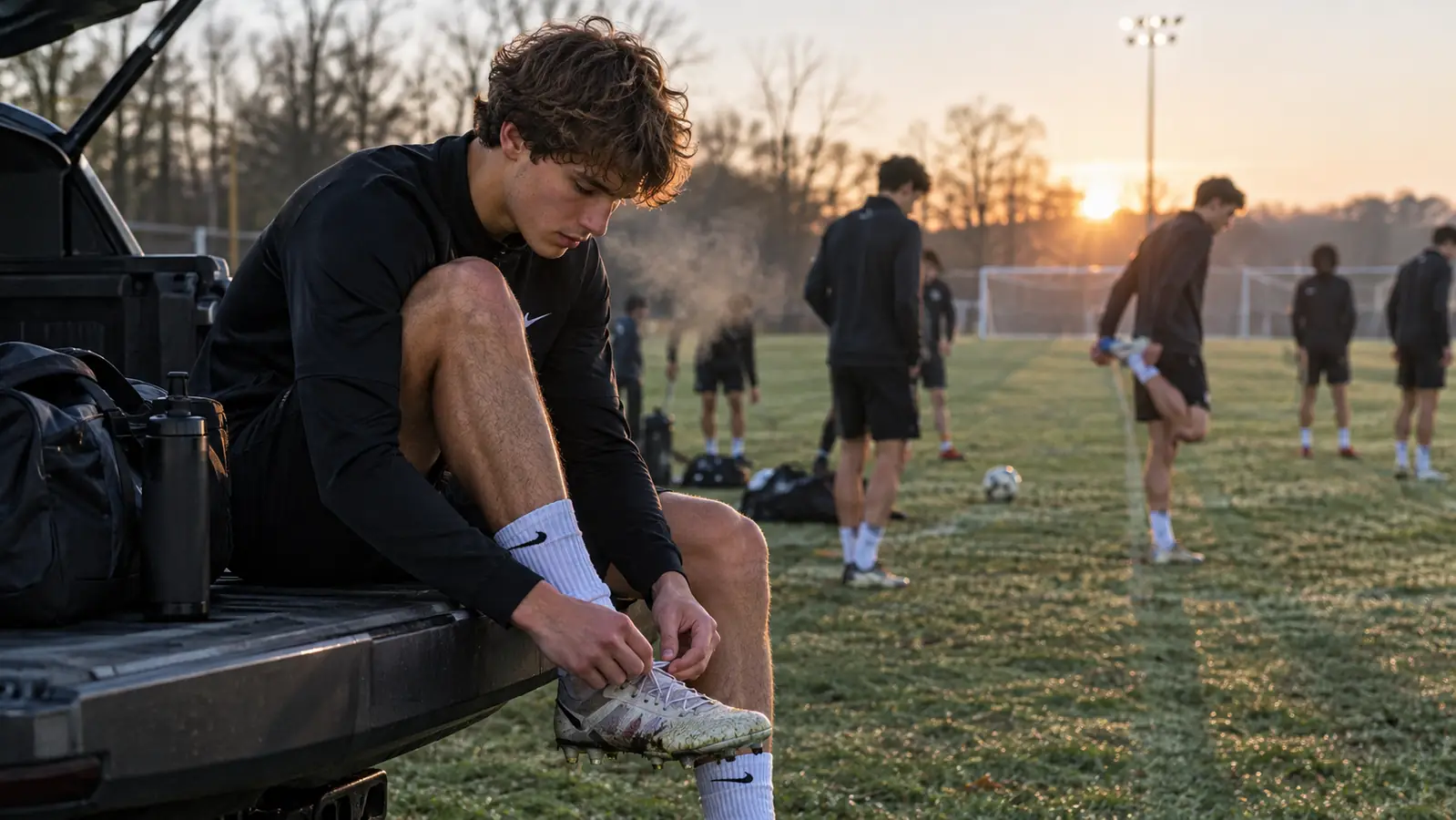
Rec-league soccer does not care that you are 49. Sunday morning in Cincinnati, the field is still soft from Saturday's rain, the guy marking you is 26 and has fresh legs, and your right ankle is the same one you rolled five years ago on a rut that looked exactly like this one. It feels loose on uneven ground now. Not sharp pain, mostly. Loose. Like a hinge with a little too much play in it, and you notice it most when you cut.
You have probably already tried the two things the rest of us try first. You taped it for a month and remembered why you quit taping: ten minutes at the kitchen counter, a roll a week, and by halftime the whole thing has loosened into a sock with opinions. Then you bought a thin neoprene sleeve, pulled it on in the car, and found out it does roughly what a sock does. Keeps the ankle warm. Does not stop the ankle from rolling. Two years ago, after the right ankle went over again on a rutted field, I bought the Med Spec ASO Ankle Stabilizer, the lace-up one, sized MD. I wear it on the right ankle only, laced over a thin sock, under my cleats. Sundays for soccer. Wednesdays for pickup basketball at the Y. That is the whole system. Nothing else about my week changed, and I am not going to pretend a piece of nylon fixed my body. What changed is that I stopped thinking about the ankle during games, which for a 49 year old who wants to keep playing is most of the battle.
The thing I lace up before every Sunday game and stopped thinking about
Med Spec ASO Ankle Stabilizer. Lace-up shell, figure-8 straps, sized MD in my case. Mine has two seasons of grass and gym floor on it and the straps still hold.
Amazon Check Today's Price on Amazon →Step 1: Get the ankle looked at before you spend anything on gear
I am not a doctor and I am not going to play one in a soccer article. When my ankle went over five years ago I did what most of us do. I iced it, I limped for a week, and I went back too soon. It was months later, when it kept giving way on curbs and in parking lots, that I finally saw a physical therapist for a handful of sessions. That is the only time I have done it, and it is still the most useful thing I have done for the ankle.
What came out of those sessions was not a brace recommendation. It was a short list of exercises and one sentence the PT said that I still hear in my head: the brace buys you time, the muscles are what hold the joint. That is the honest frame for everything below. A brace supports a joint. It does not strengthen one, and it will not make a wobbly ankle stable on its own.
So here is why this is step one in an article about gear. If the ankle is swollen, if you cannot put weight on it, if it gives way while you are just walking across a parking lot, that is a conversation for a doctor, not a shopping cart. Go get it looked at. Then come back and read the rest, because once you know what you are dealing with, the equipment part takes about twenty minutes to sort out.
Step 2: Size it right and lace it in the right order
The Med Spec ASO is sized off a chart, not off a guess. I measured once, landed on MD, and wrote the size in marker on the inside flap of my soccer duffel so I would never have to think about it again. A brace that is too big slides down into your heel by the second half. A brace that is too small will have your foot going numb before halftime. Neither one is doing the job, and both of them cost you the same amount.
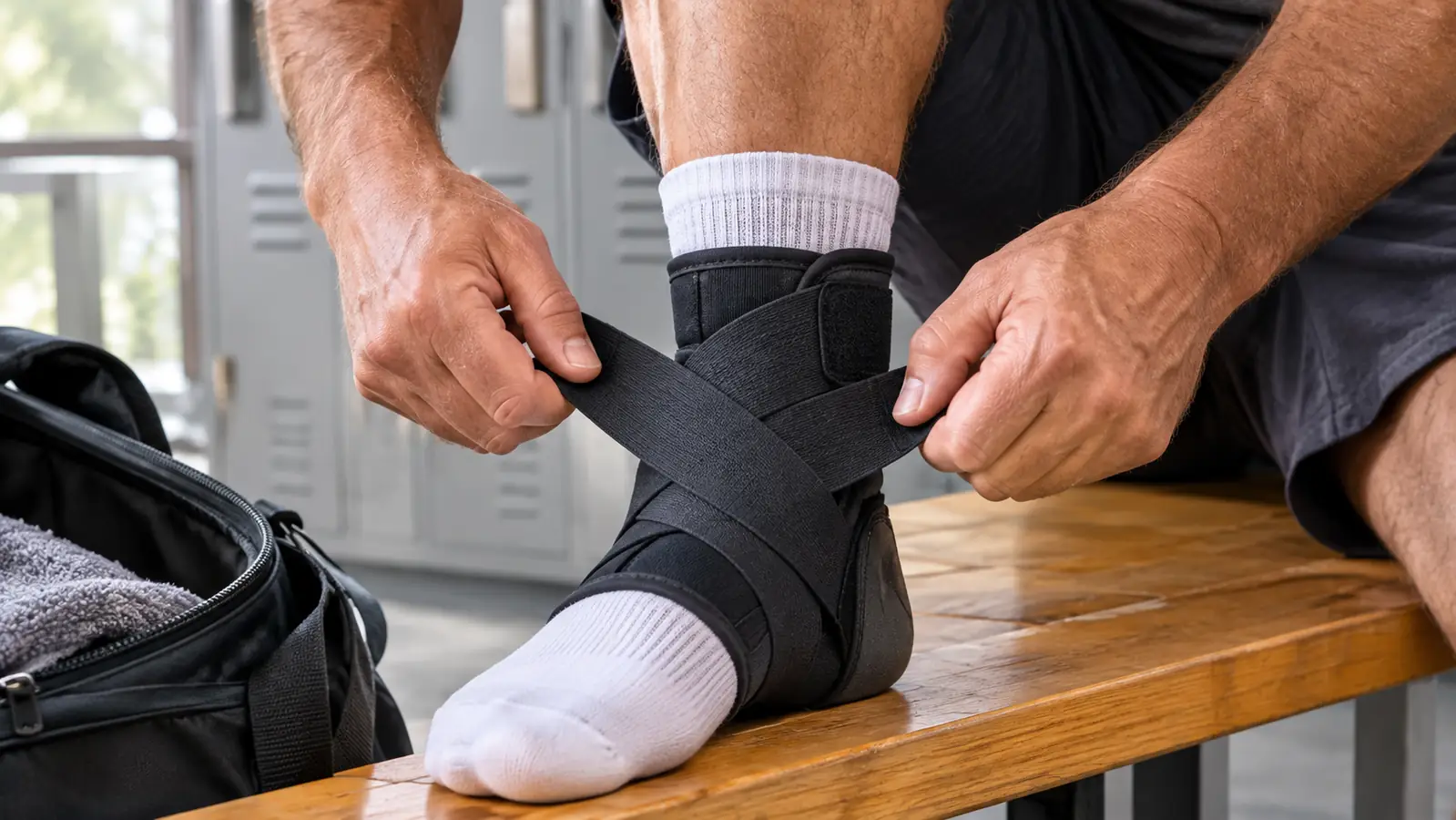
The brace is nylon, it weighs almost nothing, and it ships with an instruction card. Read the card. I say that as a man who did not read the card for the first three weeks and wore it like a sock with laces on it. The whole point of the design is the figure-8 straps. They cross over the top of your foot and around the back of the ankle, and when you get them snug and then lace the shell over the top, the brace limits the side to side roll that puts you on the ground. Lace it loose and you have bought an expensive sock.
My order, every single time: thin sock on, foot in, heel seated all the way back into the pocket, straps crossed and pulled snug, shell laced from the bottom up, top lace tied off, then the cleat over the whole thing. It takes about ninety seconds once your hands know the sequence. The first few times it takes five minutes and you will be the last one out of the parking lot.
Step 3: Break it in somewhere nobody is keeping score
The worst place to discover that your brace rubs is a Sunday match with a referee and a standings table. Before I trusted the Med Spec brace for a league game, I wore it to a Wednesday night pickup run at the Y, where the stakes are a water break and nobody remembers the score. That was the right call.
The spot that will tell you is not the ankle. It is the top of the foot, right where the straps cross. My first session, I had it too tight there and twenty minutes in my toes were filing complaints. I backed the straps off one notch and it was immediately fine. That notch is the difference between a brace you wear for two years and a brace that lives in the bottom of the bag.
Second thing I learned: the top edge of the shell sits right about where my shin guard strap lands. A thin sock fixed it. A thick sock made the whole brace feel a size too small. Give it two or three sessions before you decide anything. Nylon softens a little at the strap edges, and the lace path molds to your foot.
Two years, one brace, one size, two sports. The straps still hold and the ankle still feels loose on uneven ground. Both of those things are true at the same time.
Step 4: Build a ten minute block before kickoff and keep it boring
This is the part nobody wants to read, so I will keep it short. The brace is the smallest part of the system. I keep a set of Fit Simplify resistance loop bands in the soccer duffel, and ten minutes before kickoff, on the grass behind the goal, I do the same circuit every week. Lateral band walks with the band around my ankles, twenty steps each direction. Glute bridges with the band above my knees. Then ankle work, band around the forefoot, point and pull, both directions. That is it. Ten minutes.
Why it matters for a loose ankle: the ankle does not work alone. If the hip and the glutes are not doing their share, the ankle picks up the slack, and a loose ankle picking up slack is the ankle that goes over on a rut in the eighteenth minute. The PT showed me these exercises five years ago. I did them for a few months and then I let them slide for years, which is the most honest sentence in this article.
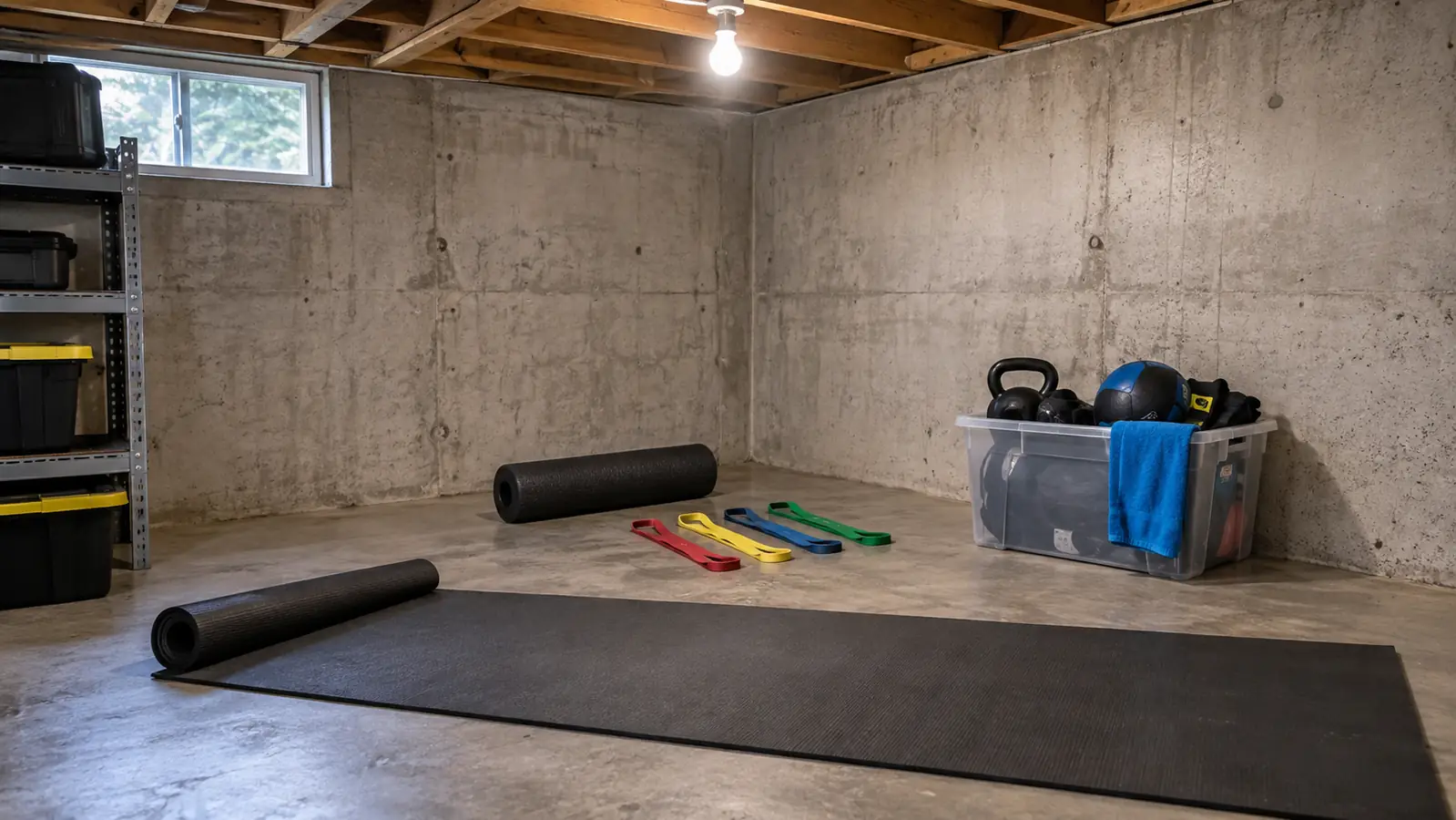
I started again about a year and a half ago, when it became clear that lacing a brace was not going to be enough forever. The bands live in the duffel on Sundays and in the basement bin the rest of the week, where I do a short session twice a week. It is not exciting and it does not make a good story in the parking lot. It is the reason the brace is not the only thing standing between me and the sideline.
Step 5: Handle the hour after the final whistle
The Med Spec brace comes off in the parking lot, not at home. That small rule made a bigger difference than I expected. If it goes into the duffel still laced and still damp, by August it smells like a locker room and the straps start to lose their body. I unlace it, lay it flat in the top of the bag, and let it air out. Every few weeks it gets washed by hand with a little dish soap and hung over the basement sink. Two years in, the straps still hold where they are supposed to hold.
Sunday night is the other half of it. Down in the basement, on the rubber mat in the corner, the Blackroll foam roller comes out. Calves first, both legs, slow. Then quads, then the IT band area on the outside of the thigh, then upper back. Never directly on the lower spine. I will be honest about what this is: it is not a treatment for anything. It just makes Monday morning feel less like Monday morning, and it keeps me from skipping Tuesday.
The massage gun stays upstairs. Lisa gave it to me for a birthday a year ago and it gets used after Wednesday basketball and on the calves after a longer run, on low speed, a couple of minutes per muscle. Never on the ankle bone, never on the kneecap, never on the spine, never on the neck. Those are the rules I follow, and they are the rules I would pass along. What I do not do: I do not sleep in the brace, I do not wear it to the grocery store, and I do not wear it for road runs. It has one job.
What Else Helps
A few things that are not gear. The field matters. Our league uses two pitches, and one of them has a crown in the middle and ruts along the touchline where the mowers turn. I am slower and more careful on that one, and no brace fixes bad ground. Cleats matter more than people give them credit for. I went to a wider fit two seasons ago and the hot spot on the outside of my right foot, the one I had blamed on the brace for a year, went away.
Scheduling matters too. If I play basketball Wednesday, run Thursday and Friday, and then play soccer Sunday, the ankle is unhappy by the second half no matter what is laced over it. I am 49. Recovery is a budget and I spent years overdrafting it. These days I pick two of those three, and the ankle notices.
And the honest one, which I will repeat because it bears repeating: talk to your doctor or a PT. If it is more than a tweak, if there is swelling that does not go down, if it gives way while you are walking, get it checked. I am a sales manager in Cincinnati who plays on Sunday mornings. That is the entire credential behind everything above.
If you are going to lace something up on Sunday, make it something that fits under a cleat
Med Spec ASO Ankle Stabilizer. Nylon shell, figure-8 straps, sized MD in my case. Two years in the duffel and it is still the first thing I pack.
Amazon Check Today's Price on Amazon →