
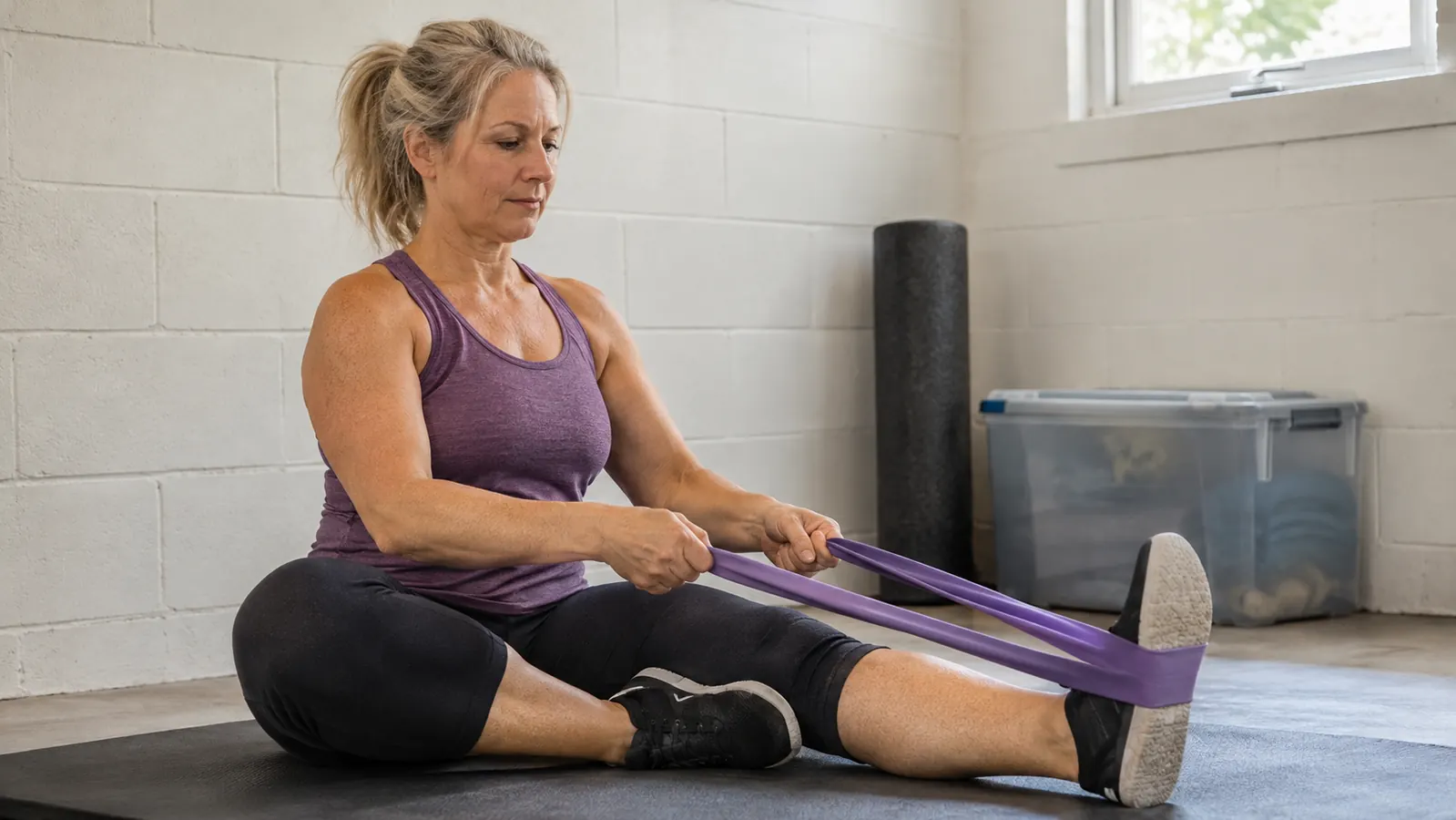
I bought the Fit Simplify loop bands eighteen months ago for a reason that had nothing to do with getting stronger. My right ankle has been unreliable since I rolled it badly in a rec-league soccer game at 44. I saw a physical therapist for a handful of sessions afterward and left with a short list of hip and ankle exercises to do at home. I did them for about three weeks and then let them slide. Five years later I was still feeling that ankle go on uneven ground every time I stepped off a curb wrong.
So this is not a review from somebody building a home gym. I am 49, I work as a sales manager in Cincinnati, I play Sunday morning rec-league soccer, I run three mornings a week, and I show up for pickup basketball at the YMCA on Wednesday nights. The bands live in a plastic bin in my basement next to a foam roller and a massage gun. Here is what eighteen months with them has actually looked like, including the parts of the set I never touch.
The Quick Verdict
Two of the five bands do nearly all the work, and that turned out to be enough. A plain, packable set that made the boring ankle and hip work easy enough to actually keep doing.
Amazon Check Today's Price →The set that made my warm-up non-negotiable
Five latex loops, a carry bag, and a printed exercise guide. The bag rides in my soccer duffel, which is the only reason the ten minute warm-up happens on cold Sunday mornings.
Amazon Check Today's Price on Amazon →What Nobody Tells You About a Five-Band Set
Here is the part the product photos skip. In eighteen months I have used two of the five bands with any regularity, and both of them sit on the lighter end of the set.
That is not a complaint about Fit Simplify. It is how loop bands work. The five bands run from extra light up to heavy, and the resistance is fixed inside each loop, so the only way to change the load is to grab a different band. For the ankle work and the lateral walks the therapist gave me, light resistance was the entire point. A loose ankle does not need to be overloaded. It needs to be reminded, twice a week, that it has a job.
The heavier bands are still in the bin and still clean. I use one of them for glute bridges on the weeks my lower back has tightened up after a long drive, and that is the whole story. If you buy a five band set expecting to climb from band one to band five like rungs on a ladder, you will probably land where I did. The progression happens in the movement, not in the band.
So do you need all five? Honestly, if somebody sold a three pack with the two lightest loops and one middle one, I would tell you to buy that instead. But the set is sold as a set, the unused loops weigh almost nothing, and having the heavier ones around meant I tried glute bridges with more resistance than I otherwise would have. That is a small win, and I will take it, but I am not going to pretend I am getting value out of all five.
How I've Actually Used Them
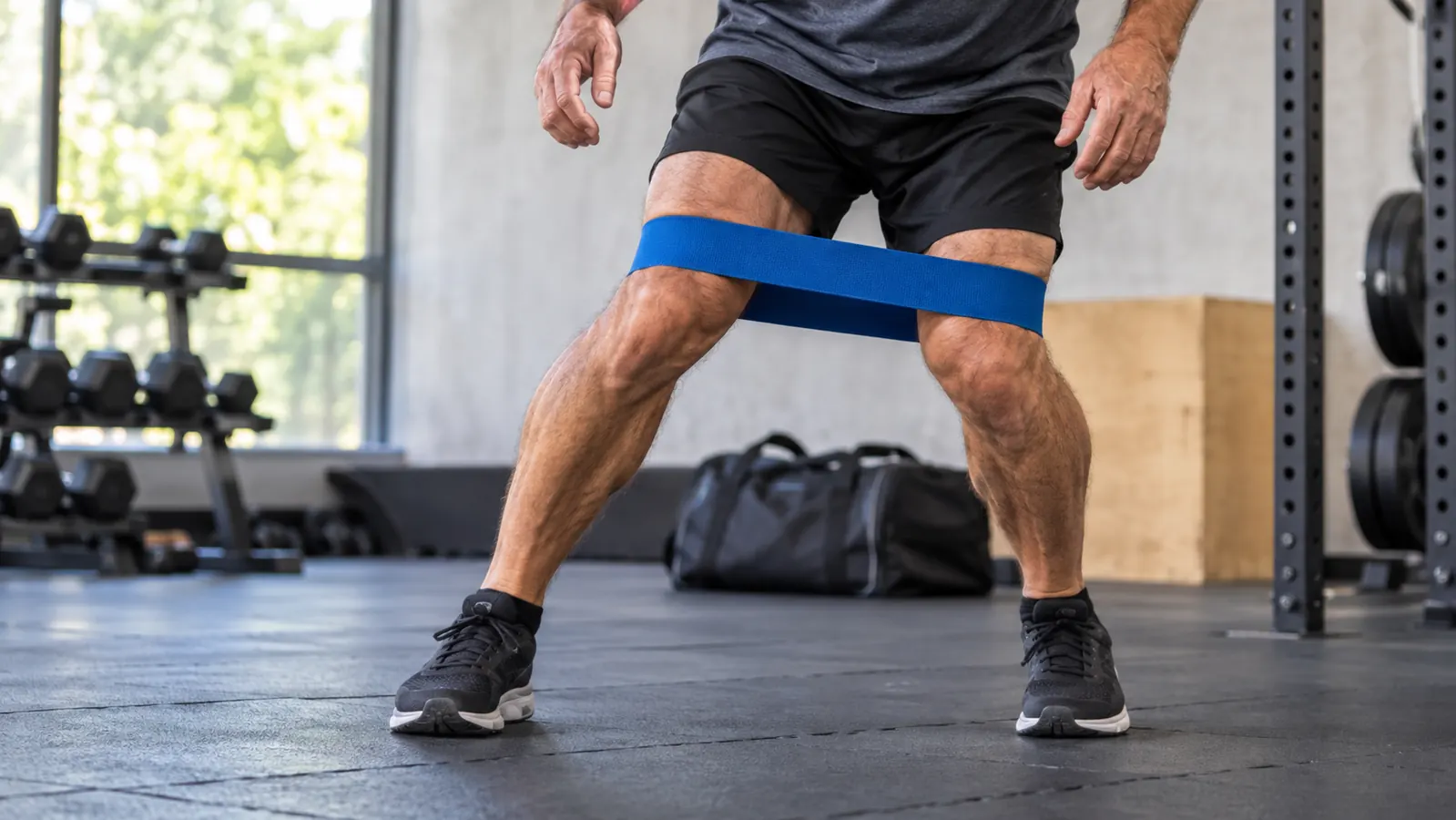
Sunday mornings, before I leave for the field, I do ten minutes on the rubber mat in the basement. Lateral band walks around the loop a few times in each direction. Glute bridges with a band above the knees. Then a few ankle exercises, sitting on the edge of the mat with the loop hooked around one foot and the other leg out straight.
Then I fold the band, drop it in the carry bag, and the bag goes into my soccer duffel. That was a deliberate choice. When the bands lived only in the basement, I did the warm-up on the Sundays I remembered and skipped it on the ones I did not. Once they travelled with me, the warm-up happened in the parking lot before the game, which turned out to be a far easier habit to keep than a quiet appointment with myself at six in the morning.
The second session is at home, twice a week, usually Tuesday and Thursday after work. Twenty minutes, same movements, plus some hip work on the days my back is complaining after a long stretch in the car. That is the entire program. It is not impressive and I am not going to dress it up. It is the work I should have been doing since I was 44, and the bands are the reason it finally stuck, mostly because there is no setup to talk myself out of.
Basketball nights get a shorter version, more hip work than ankle, since the ankle is under a lace-up brace for that anyway. The brace stays in the duffel. The bands stay in the bag. Nothing in my setup requires me to think about it, which is the only reason any of it survives a busy week.
What Is Actually in the Set
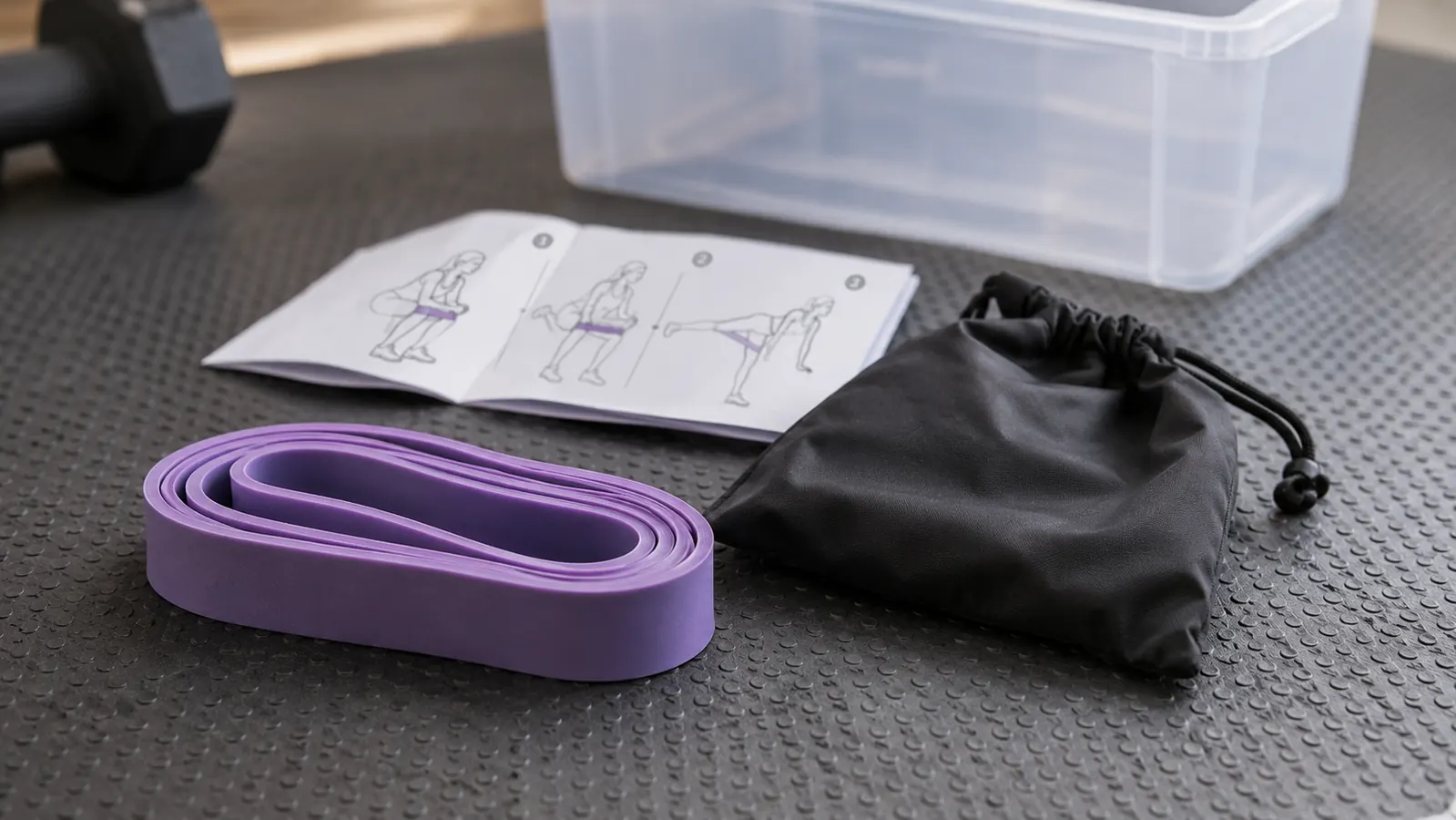
Five latex loop bands, each about twelve inches long and three inches wide, a quarter inch thick. The full set weighs three and a half ounces, which is why it vanishes into a duffel and why I have never once left it at home out of laziness. There is a carry bag, and there is a printed instruction booklet with illustrated exercises inside it.
The booklet is better than I expected and worse than I wanted. It covers dozens of movements and it is genuinely useful if you have never used a loop band and have no idea where to begin. But it is general. It does not know that my right ankle is loose on uneven ground, or that the soreness below my left kneecap shows up when I add mileage too fast. For that part I used the list the therapist gave me, and the bands were simply the tool that let me run that list in my own basement.
Worth saying out loud: latex is latex. There is a faint rubber smell out of the bag that fades over a couple of weeks. The bands collect dust and lint from the mat, so I wipe them down every so often. Neither of those is a defect. It is the material doing what the material does, and it is also why the band grips your legs during lateral walks instead of sliding down to your ankles.
The carry bag is a small thing that turned out to matter more than the bands themselves. It is not fancy. It is a drawstring pouch. But because the set has a home that fits in a duffel pocket, the bands go where I go, and the whole habit depends on that.
Where They Have Held Up, and Where They Have Not
Eighteen months of twice weekly use, plus a warm-up most Sundays, and all five bands are intact. The two I use most have gone a little tacky and less crisp than they were new, which is normal for latex and has not changed how they behave. No tears, no snapping, nothing stretched out at the edges.
The complaints I have are small and all of them are about how loop bands work rather than about this set in particular. They roll. A loop band rolls up on your legs during lateral walks, and when it rolls, it pinches. I have gotten better at keeping it flat against the skin, but it still happens with the heavier band and it is the most annoying thing about the product.
They also give you no way to fine tune. I can move from the light band to the next one up, but I cannot add ten percent. If you are the sort of person who likes dialing in exact loads, this set will drive you up a wall. A set of tube bands with handles solves that better than loops do, and I would not argue with anyone who went that direction.
The obvious safety note applies here too. Latex bands do eventually fail, they can snap back at you when they do, and you should look yours over for nicks before you stretch one across the room. I have not had one let go on me, but I check the light band every Sunday before I use it, because it is the one taking the most stretch around an ankle.
One more detail nobody puts in a listing. The three inch width is wide enough that the band stays put on my thighs and wide enough that it does not dig in, but it is also wide enough that folding it into a small loop for ankle work takes a couple of tries to get flat. That is a two second problem, not a real one, but it is the kind of thing you only learn after a month.
What These Bands Will Not Do
They will not fix my ankle. Nothing is fixing my ankle at this point. What they do is let me keep the ankle and hip work inside my week, which is the difference between a joint that feels loose and unpredictable and one that at least gets its maintenance done. If you are expecting a set of loop bands to resolve an injury, put them down and go see someone who can actually assess you. I am not a doctor or a physical therapist and I am not going to write like one.
They will not replace a gym either. If you want to load real weight, loop bands are a warm-up tool and a prehab tool, not a training program. And they will not tell you when you are doing a movement wrong, which is the thing I would most want from a booklet and the exact thing a booklet cannot give you. That is what the handful of PT sessions were for, and I would spend that money again before I spent it on gear.
What they will do is remove the excuses. There is no drive across town, no loading plates, no wiping down a machine. The band is in a bag in my duffel or coiled in the bin, and the whole session takes less time than the drive would have.
What I Liked
- Five resistance levels cover the range I actually need for ankle and hip work
- The whole set weighs three and a half ounces, so the warm-up travels to the field with me
- Latex grips well enough to stay put during lateral walks
- The printed booklet with illustrated exercises gives a beginner somewhere to start
- Eighteen months of twice weekly use with no tears and nothing stretched out
Where It Falls Short
- I use two of the five bands. The other three mostly sit in the bin
- Fixed resistance with no way to fine tune between bands
- They roll and pinch on the heavier band during lateral walks
- Faint latex smell for the first couple of weeks
- The booklet is general, not a program built around your specific problem
Eighteen months, twice a week, no tears and no snapping. Two of the five bands did all of it, and that is the honest number.
Who This Is For
This set makes sense if you are in the spot I was in. An aging weekend athlete with a short list of exercises from a doctor or a physical therapist and no good excuse for skipping them. If you need something packable that lets you do ankle work, hip work and a five minute warm-up before you play, the Fit Simplify set does that and nothing more. It is also a fair starting point if a professional has told you to begin with light resistance and you have no idea what that means in practice.
It also makes sense if you have tried and failed to build a home routine before, the way I had. The reason this one stuck for me is not the bands. It is that the bands were already in the bag, and the bag was already in the duffel, and the duffel was already going to the field. Whatever routine you have failed at three times, the fix is usually about removing a step, not about buying better equipment.
Who Should Skip It
Skip it if you want progressive loading with real numbers. A set of tube bands with handles, or a handful of dumbbells, gives you a way to add load in small steps and this set does not. Skip it if you are working through something no professional has looked at, because a printed booklet is not an assessment and I would not trust it as one. Skip it if latex is a problem for you, for obvious reasons.
And skip it if you want gear that feels like gear. This is five loops of rubber in a little pouch and it is never going to feel like anything else. If you are the kind of person who stays consistent because the equipment is nice to look at, spend your money somewhere else. If you stay consistent because the equipment is already in the bag when you walk out the door, this is exactly right.
One Last Thing, From the Parking Lot
The note I would give a teammate in the parking lot after a game is this. The bands did not change anything by themselves. Doing the exercises changed things, and the bands only made the exercises easy enough to keep doing on a Tuesday night when I would rather sit down. If you have a list of exercises from a professional and the list is the part you keep skipping, that is the gap this fills.
Mine has been in the bin for a year and a half and it will stay there. The light band is getting worn, and when it finally goes I will replace the set without thinking about it. That is about the strongest thing I can say about a piece of recovery gear.
If the exercises are the part you keep skipping, start here
Five latex loops, a carry bag, and an illustrated guide, in a set light enough to live in your duffel. It is the least interesting thing in my recovery bin and the one I reach for most.
Amazon Check Today's Price on Amazon →