
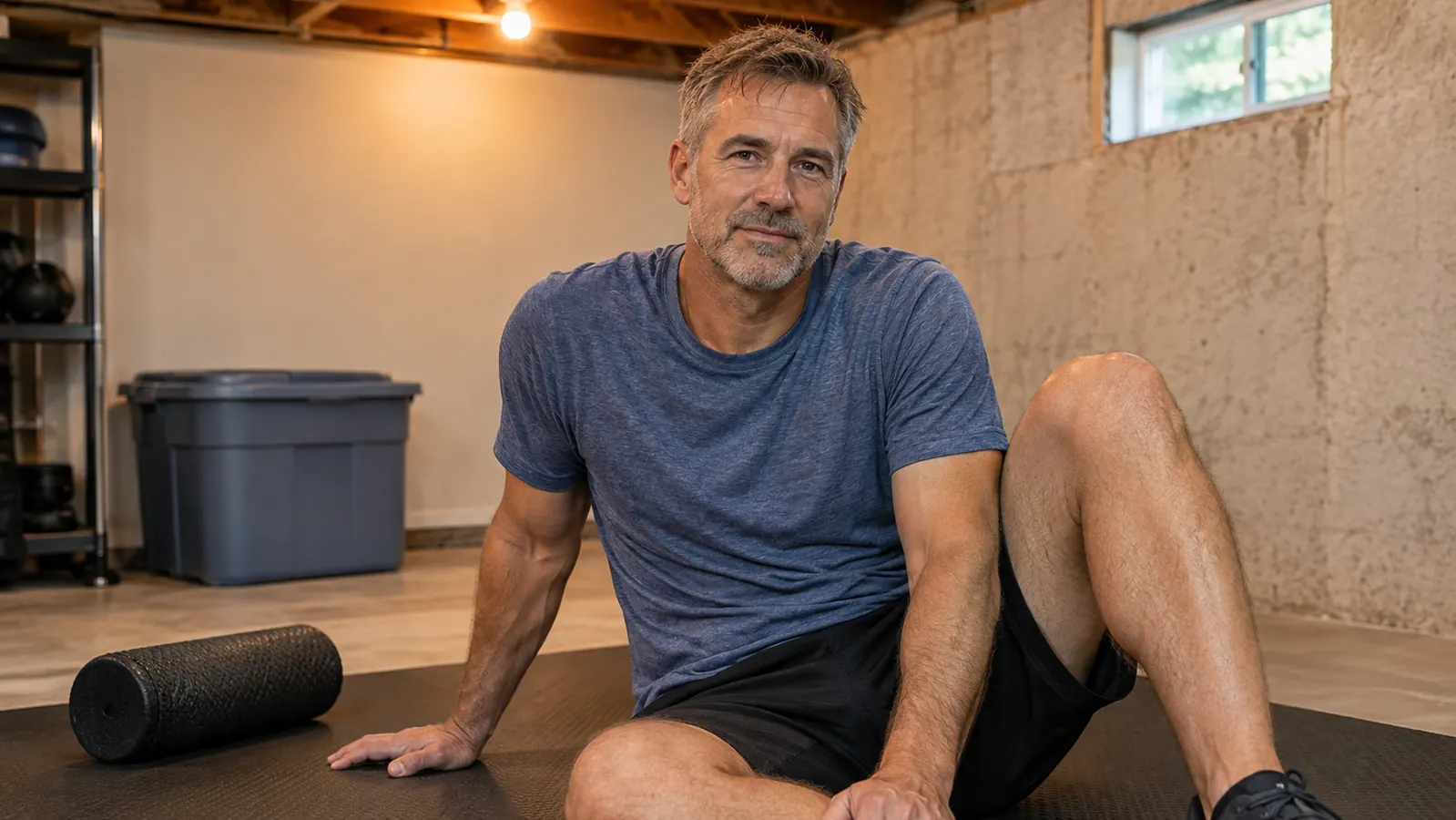
The lower back thing never announces itself. I stand up out of the car after a two-hour drive and it is just there, a band of tightness across the belt line that makes my first ten steps look like a man twenty years older than me. Same story on Thursday mornings after Wednesday basketball at the YMCA. I am 49, I run three mornings a week, and I have played Sunday morning rec-league soccer for about fifteen years. My back has an opinion about all of it, and it is not a quiet one.
Here is what I have worked out in the corner of my basement, on a rubber mat, over about three years of trial and error. A foam roller does not fix a lower back. What it does is get the muscles around it, the glutes, the quads, the calves and the upper back, to let go enough that the lower back stops doing work it was never supposed to do. That is the entire trick, and it took me an embarrassingly long time to believe it. My roller is the Blackroll standard, twelve inches long and six inches across, and I have owned it longer than anything else in the plastic gear bin down there. It is dense and it has held its shape through three Cincinnati summers. What follows is the routine I actually do, not the one I read about once and abandoned.
The twelve-inch roller I have kept for three years and still use every Sunday night
Short enough to fit between my shoulder blades, dense enough that it has not flattened out like the cheap one before it. It lives in the plastic bin and comes out after soccer.
Amazon Check Today's Price on Amazon →The Five Steps I Actually Do
Step 1: Get down there and find out what is actually tight
Before I touch the roller, I lie on my back on the mat with my knees bent and breathe for a minute. Then I check. Can I pull my right knee across my body without the back grabbing at me? Does the left hip open as far as the right one does? Nine times out of ten the back feels tight but the hip on one side is the thing that is genuinely stuck. That was a real surprise to me. The back is usually the messenger, not the criminal.
This is also the moment where I decide whether I am rolling at all. If it is the usual end-of-day ache, the kind that shows up after a long drive or a Thursday morning after basketball, I roll. If anything shoots down a leg, or I get numbness or tingling, or the pain is sharp instead of dull, I stop and call my doctor. I am not a physical therapist and I am not going to play one on the internet. That decision is above my pay grade, and the one time I did see a PT, after the ankle sprain five years ago, he was worth every minute of the drive.
One more habit I stole from a running friend: walk for five minutes first. Rolling a cold back in a cold basement at nine at night is not the same as rolling one that has a little blood moving through it. It sounds fussy. It is not. It is the difference between the roller helping and the roller just hurting. Some nights the five-minute walk is the entire session, and I count that as a win.
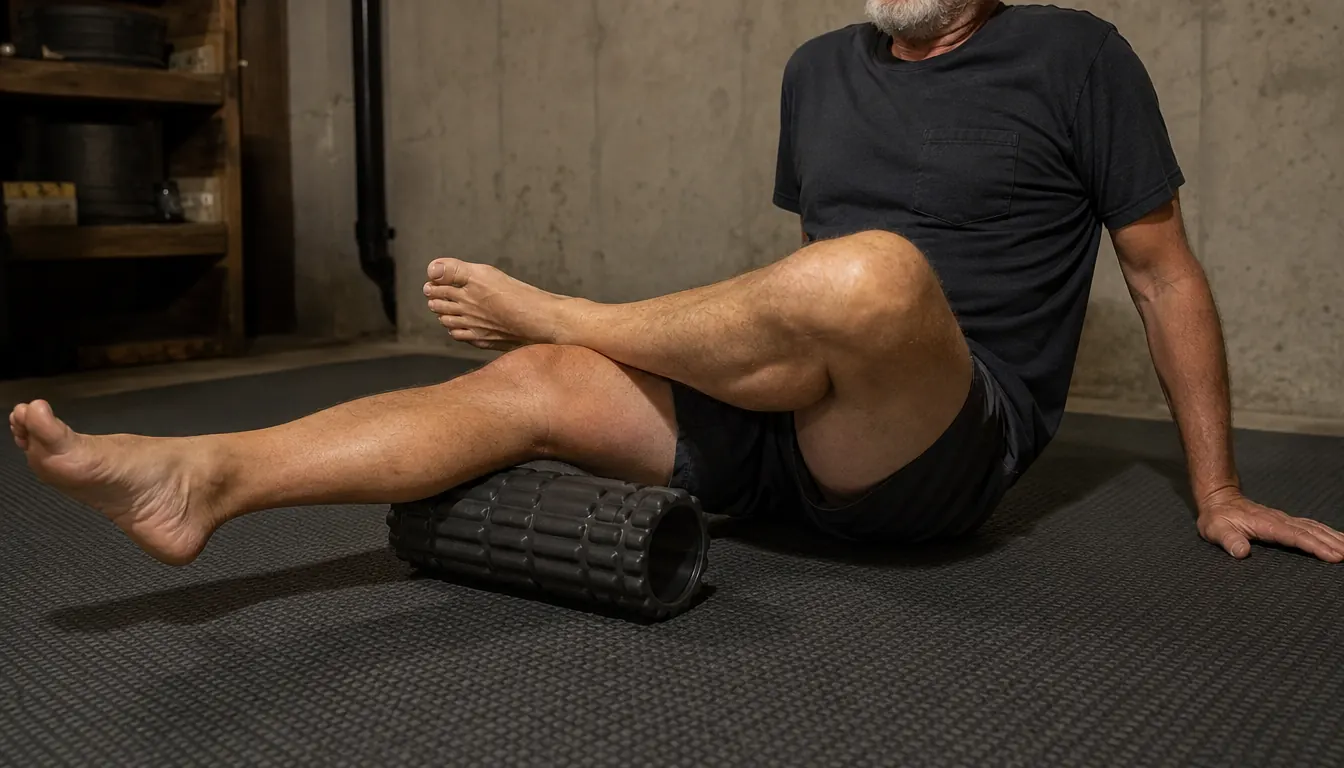
Step 2: Glutes and hips, because that is where the tension is coming from
I sit on the roller with one ankle crossed over the other knee, lean back on my hands, and roll slowly across one side of my backside. Short passes, maybe three or four inches at a time. When I hit the spot that makes me wince, I stop on it and breathe there for thirty seconds instead of grinding back and forth like I am trying to sand it off. Then I switch sides and repeat. The left side is always worse. It has been worse since the knee started complaining and I began favoring it without noticing.
The reason I start here is not complicated. I spend forty hours a week at a desk or in a car, then I go play basketball, and the muscles back there get tight and stay quiet about it for weeks. When they are tight, the lower back picks up the slack. Loosen the glutes and the back gets a break it did not have to ask for. I learned that from a running friend who had the same complaint, and I have yet to find a week where it was wrong.
Thirty to sixty seconds a spot, no counting reps. If I catch myself holding my breath, I am pushing too hard and I back off. That rule alone has saved me more soreness than any single stretch. My roller being twelve inches long means I can sit on it without fighting for balance, which matters more than I expected the first month I was learning this.
Step 3: Quads and the front of the hip
Face down, roller under the front of one thigh, forearms on the mat for support. I work from just above the knee up toward the hip, slowly, evenly, and I never put weight on the kneecap itself. The left leg gets the extra time. That is the knee that gets sore just below the cap when I add mileage too fast, and the quad above it tightens up in sympathy. I know that now. I did not know it the first year.
This is the step I skip when I am running late and the step I regret skipping every single time. When the front of the hip is tight, I stand with my pelvis tucked and my lower back flattened out, and by dinner it aches. Ten passes on each side. That is all it takes, and it is why I do not skip it anymore. My wife Lisa can tell from across the kitchen whether I did it or not, just from how I stand at the counter.
If the mat work is new to you, go lighter than you think you should here. The front of the thigh is a lot less forgiving than the backside, and a bruise from overdoing it on a Tuesday will keep you off the roller for a week. Slow beats hard. That is the whole lesson of this step.
Step 4: Calves, which sound unrelated and are not
I sit on the mat with the roller under one calf and my other leg stacked on top for weight, and I roll from the ankle up to the back of the knee, flexing and pointing the foot as I go. The right side is the tight one. I rolled that ankle badly in a soccer game at 44 and it has never fully trusted uneven ground since. The calf on that side has been doing extra work ever since, and it lets me know about it on the days after a long run.
I did not believe the calves mattered for a back until I started keeping a note on my phone after Sunday soccer. On the weeks I did the calves, the Sunday night backache was smaller. On the weeks I skipped them, it was not. That is not a study, that is one guy with a notes app. But I will take a pattern I can see over an opinion I cannot.
The other thing that happens here is I find out how the ankle is doing. If the calf is tight all the way down to the heel, I know I have been walking carefully on that side again and I need to get back to the band work. That little check has caught two flare-ups before they turned into anything.
Step 5: Upper back, and keep the roller off your lower spine
I lay the roller across my upper back, roughly at the shoulder blades, cross my arms over my chest, and let my head and shoulders drape back over it. Then I move it an inch at a time. This is the most relaxing part of the whole routine, and it is also the part where people get themselves in trouble, because it feels so good that they keep going in the wrong direction.
The lower spine does not get rolled in this house. Not by me, not ever. The bones back there are not muscle, and a dense cylinder is not going to do them any favors. I stay off the bony points at the top of the hips too. When I want work in the lower back area, I get it through the glutes and hips in Step 2 and through stretching, not by parking the roller on my spine and rolling around on it. If your instinct is to go straight at the spot that hurts, that instinct is wrong here.
My Blackroll is the standard model, twelve inches long and six inches across, which is short enough to fit between my shoulder blades and wide enough that I am not fighting to balance on it. It is dense and it has held its shape for about three years, which is more than I can say for the cheap one I had before it, which flattened out inside a summer. It lives in the bin with everything else and comes out on Sunday nights after soccer, when my legs are done and my back is deciding how the week is going to go. Total time for all five steps on a normal night is about twelve minutes, and on a bad night closer to twenty.
Nine times out of ten the back feels tight, but the hip on one side is the thing that is actually stuck. The back is the messenger, not the criminal.
What Else Helps
The roller is the tool, but three other things in that bin do more than I expected when I started paying attention. The first is breathing. Slow, out through the mouth, while I am sitting on a tender spot. It sounds like nothing. It is not nothing. Half the time the muscle I am chasing lets go on an exhale and never would have on a grind. I figured that out by accident during a week when I was too tired to push hard, and it turned out the tired week was the better one.
The second is the massage gun Lisa gave me for my birthday last year. It is rechargeable off a USB cable and came with a case and ten attachment heads, most of which I have never used. I use it on low speed for a couple of minutes on my glutes and calves after Wednesday basketball, and that is it. Never on the spine, the neck, the kneecap or the ankle bone. It loosens me up enough to sleep on a Wednesday, and for a 49-year-old with a Wednesday night habit, sleeping is the whole job.
The third is a set of resistance loop bands, and it is the one I would keep if I had to give the rest away. A year and a half ago I finally got serious about the hip and ankle exercises the physical therapist gave me after the ankle sprain, the ones I had let slide for years. Now I do ten minutes of lateral band walks and glute bridges before soccer, plus a short session at home twice a week. A hip that moves is a back that complains less. That has been the biggest single change, bigger than the roller, and I say that as somebody who loves the roller.
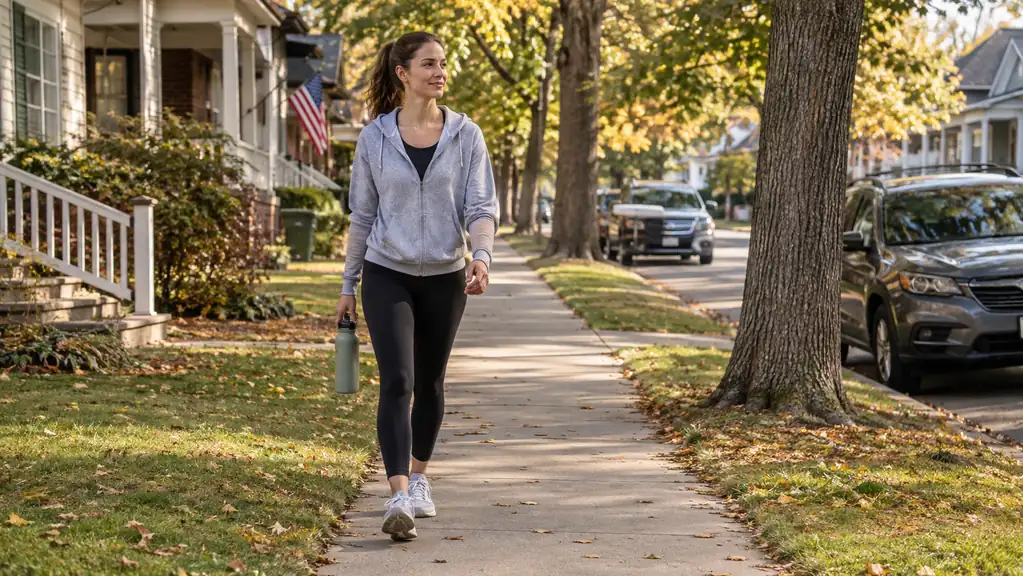
And walking. Twenty minutes the day after a game does more for my lower back than an hour on the floor does. It is boring advice and it works anyway. I do it in the neighborhood after dinner, usually with Lisa, and it has quietly become the part of the week I would miss most if it went away.
If I had to rank them for a tight lower back, it would go bands first, walking second, the Blackroll third, and the massage gun a comfortable fourth. But the roller is the one I reach for on a Sunday night when I am tired and stiff and I have twelve minutes and no ambition, and that is worth something on its own.
Last thing, and I mean it. If you have been at this for two or three weeks and nothing has changed, or it is getting worse instead of better, go see a doctor or a physical therapist. A foam roller is maintenance for a body that is basically fine. It is not a diagnosis, and it is not a substitute for somebody who knows what they are looking at.
Twelve minutes on the mat, twice a week, is what kept me playing
Nothing dramatic. A short, dense roller that fits between the shoulder blades and holds its shape, plus a routine I can do in the basement without thinking too hard about it.
Amazon Check Today's Price on Amazon →