
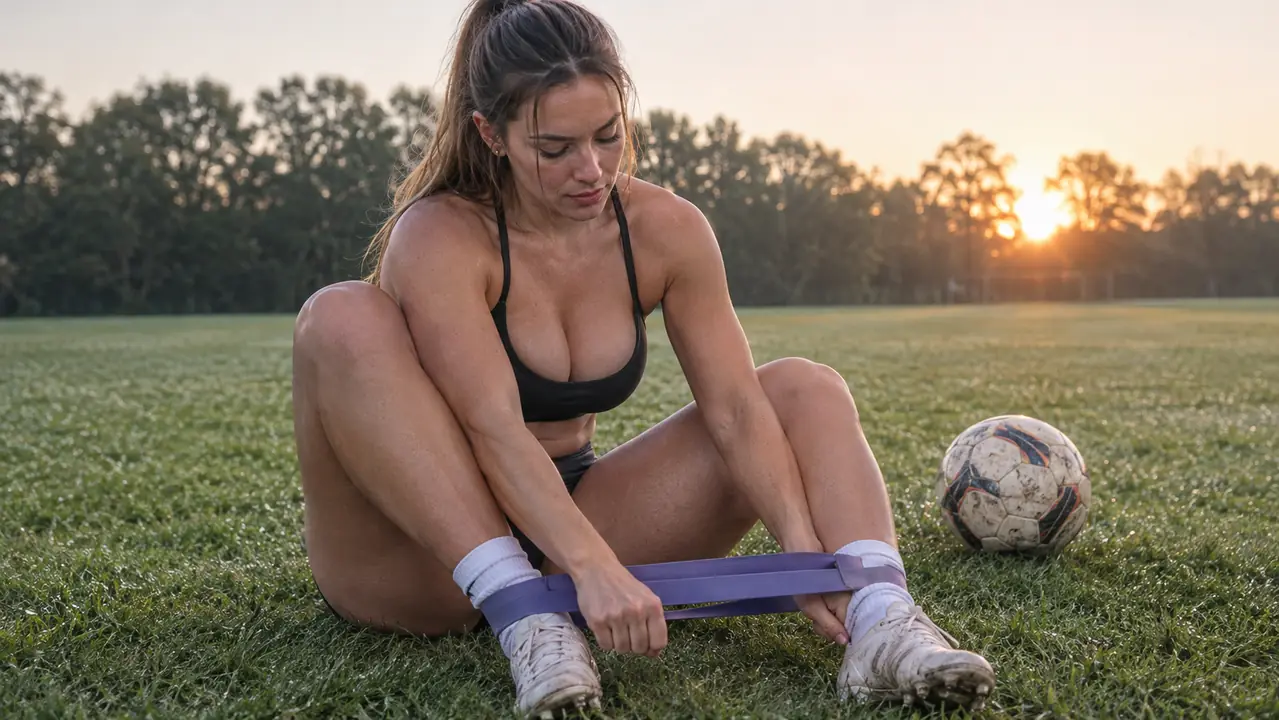
Five years ago my right ankle rolled on a rutted field, and it has felt loose on uneven ground ever since. My left knee gets sore just below the kneecap whenever I add running miles too fast. I am 49, I play Sunday morning rec league soccer in Cincinnati, and I have stopped treating the ten minutes before kickoff as optional. Stepping out of the car and asking my legs to sprint is how I used to start a game. It is not how I start one now.
About a year and a half ago I finally got serious about the hip and ankle exercises a physical therapist showed me after that ankle sprain, the ones I had let slide for years. I bought a set of five Fit Simplify resistance loop bands, dropped the carry bag in my soccer duffel, and built a ten minute routine I do on the sideline before every Sunday match. Nobody watches me do it. There is no gym and no equipment beyond what fits in a bag the size of my hand. But I walk onto the field already warm instead of using the first fifteen minutes of the game to get there, and I have not tweaked anything since I started.
Five bands, one small bag, ten minutes before kickoff
The set I use is the Fit Simplify loop band set: five latex bands in five resistance levels, an instruction guide, and a carry bag. The whole thing weighs 3.5 ounces, so it lives in the duffel and I never have a reason to leave it in the car.
Amazon Check Today's Price on Amazon →Why Bands Instead of a Jog Around the Lot
Jogging is not useless. It raises your body temperature, which is half the job. The other half is waking up the small muscles around the hip and ankle that hold you upright when you plant and turn, and a slow jog across a parking lot does not ask much of those. Mine were asleep for years and I did not know it until the ankle went.
Static stretching before a game is worse than nothing for me. Hold a hamstring stretch for thirty seconds and I feel slower for the first twenty minutes of the match. Bands let me load the joint while it is moving, which is closer to what ninety minutes of soccer will actually ask for.
The other reason is practical. Five loop bands and a carry bag fit in a duffel pocket. I can run this routine on grass, on gravel, or next to my car in the lot, and I can talk to a teammate while I do it. Nothing here needs a mat, a trainer, or a screen.
The Order Matters More Than the Exercises
I did not pick this order because it looks neat on paper. I picked it because of what fails first on a Sunday morning. My ankles are the least reliable part of me, so they go first, while I am still fresh and willing to go slow. The hips come next because they feed everything above and below them. The knee work comes after that, then the upper body and the ball, right before I run.
The other rule is that nothing in this routine is hard. If I finish ten minutes out of breath and shaky, I did it wrong and I will pay for it in the second half. The goal is warm and switched on, not tired. I save tired for the game, and honestly for the drive home.
Step 1: Wake Up the Ankles First
My right ankle is the reason this step exists, but it earns its spot for anyone playing on a field with ruts in it. Sit down on the grass and loop one band around both feet, then slide your feet apart until the band is snug. Hold one foot still as the anchor and press the other foot outward, away from your body, for fifteen slow reps. Then press that same foot inward, across your body, for fifteen more. Finish by pointing the toe down and pulling it back up against the band fifteen times. Switch feet and repeat.
Slow is the point. If you rush this, the ankle does not get the message and you have done a cardio warm-up with extra steps. I aim for about two seconds out and two seconds back, and I breathe the whole way through instead of holding my breath like I am lifting something heavy.
What it should feel like is a working burn on the outside and the front of the ankle, never a pinch at the joint itself. If it pinches, use a lighter band or shorten the range. My right ankle is the one that tells me when I have been lazy about this, usually on a Monday morning when I take the basement stairs sideways.
Step 2: Lateral Band Walks for the Hips
Put the band around both ankles, or just above the knees if your ankles are cranky, and drop into a half squat. Take ten steps to your left without letting your feet come together, then ten steps back to your right. That is one round and I do two. Toes point forward the whole time. Stay low between steps, because standing up and resetting is how this turns into a pointless shuffle across the grass.
You will feel it in the outside of the hip, which is the muscle that keeps your knee from collapsing inward when you cut. For me it is also the difference between feeling stable on the first sprint and feeling like a newborn deer on ice.
One thing I got wrong for months: I used the lightest band in the Fit Simplify set for every single movement. The band walks are the one place I want a heavier band, because the hips are strong and a light band just slides up my legs and does nothing.
Step 3: Glute Bridges With the Band Above the Knees
Lie on your back with the band above your knees, feet flat and about hip width apart. Push through your heels until your hips are up, push your knees out against the band at the top, and hold for a two count. Fifteen reps, two sets. This is my favorite part of the routine, mostly because I can still hold a conversation while I do it and partly because it works.
The cue that matters is the knees pressing out, not how high your hips get. Lifting your hips a foot off the ground with your knees pointing at each other does nothing for you once the ball is in play. Two sets of fifteen with a real squeeze beats thirty sloppy ones.
Step 4: Straighten the Knee Against the Band
This is the one I do for the sore spot below my left kneecap. Sit on the ground with one leg out straight. Loop the band around the sole of that shoe, hold the far end near your hip so there is tension, and press the back of your knee toward the ground while you straighten the leg. Hold for two seconds, then let it come back slowly. Fifteen reps on each side, and I go light on this one.
It is a small movement and it looks like nothing from ten feet away. That is fine. The muscles above the knee doing quiet work before I ask them to run and jump for ninety minutes is exactly the point, and my knee lets me know about it when I skip this step for a few weeks.
Step 5: Pull-Aparts, Then a Ball at Your Feet
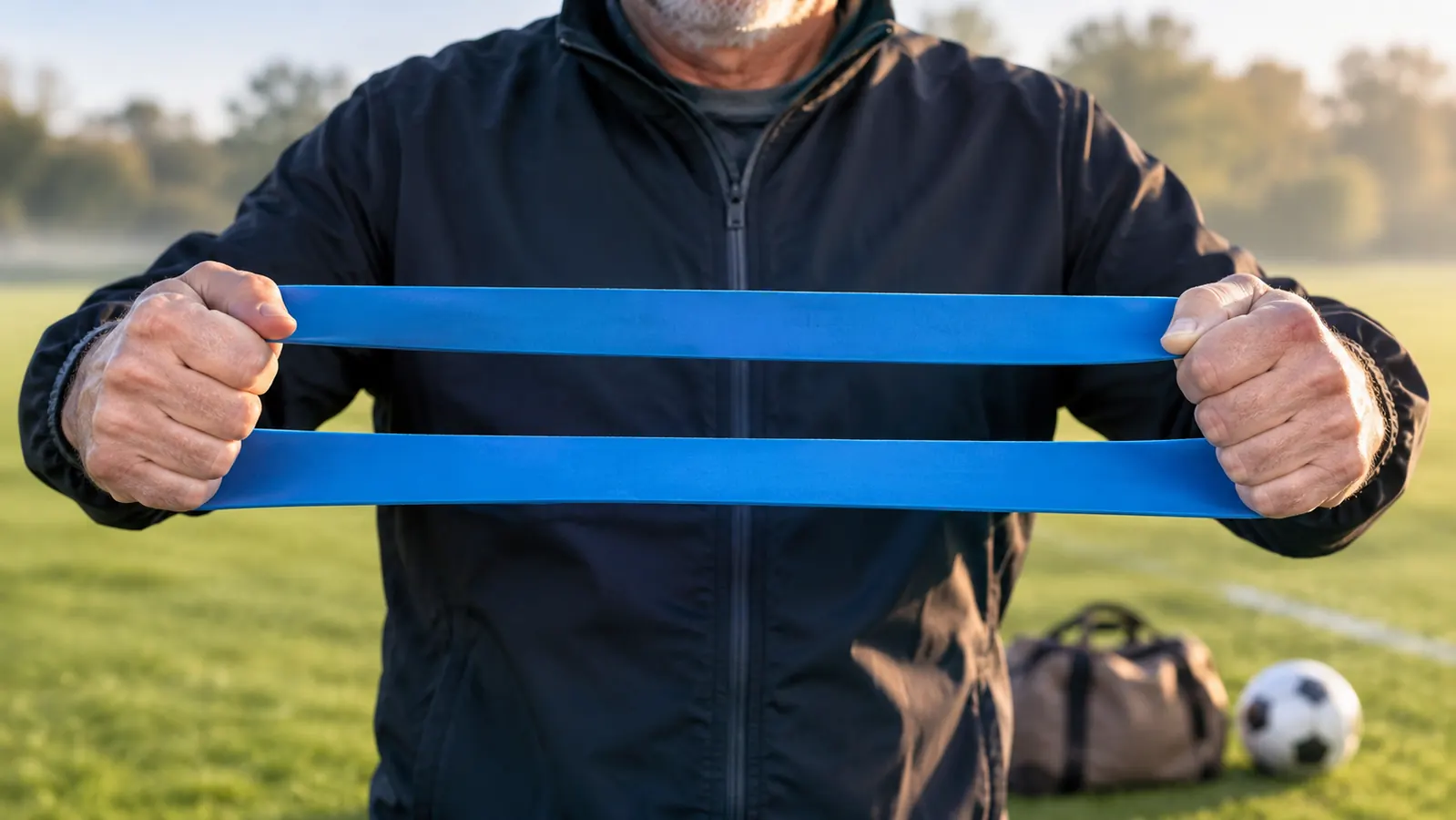
Last band movement. Hold the band with both hands at chest height, arms straight, and pull it apart until it touches your chest. Squeeze your shoulder blades for a second and come back slow. Fifteen reps. My upper back feels like a plank after a week of driving and desk work, and this is the fastest way I know to loosen it before throw-ins and headers.
Then put the band away and finish with the ball at your feet. Twenty touches, a few walking lunges, four or five leg swings on each side, and two build-up runs at about seventy percent. The last thing I do is two short accelerations, ten yards each, because the first sprint of the game should not be the first sprint of my day. By the time the whistle goes I am warm, I am breathing harder than usual, and I am ready to be average at soccer for ninety minutes.
Ten minutes with five bands, and the first fifteen minutes of the game stopped being my warm-up.
What Else Helps
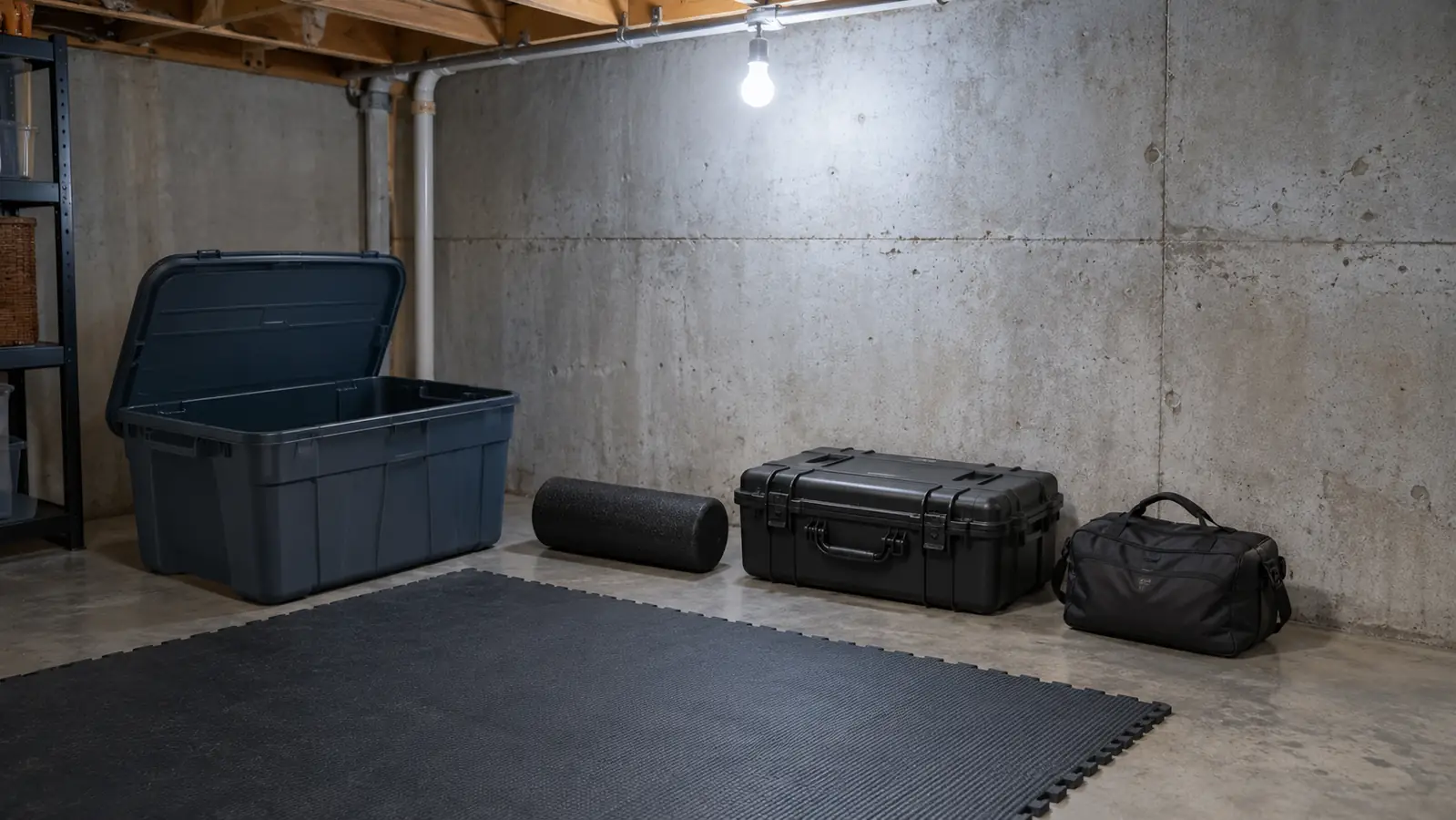
The bands are the front end of this, but they are not the whole thing. On Sunday nights after soccer I roll out my calves, quads and the outside of my thighs on a foam roller on the mat in the basement, and I stay off my lower spine with it. Mine is dense and holds its shape, which is what I want. Eight minutes of that while the game I actually care about is on, and Monday is a lot friendlier.
After Wednesday pickup basketball at the Y, I use a massage gun Lisa gave me for my birthday. Low speed, a couple of minutes per muscle, mostly calves and quads. Never on the ankle bone, the kneecap, the spine or the neck, because those spots are not asking to be pounded.
On Sunday mornings I lace a brace over my right ankle, over a thin sock, under my cleats. It does not come on road runs, only soccer and basketball. My runs get a patella strap just below the left kneecap. Neither of those is doing the warm-up for me. They just make the joint a little happier while I do the actual work.
And twice a week, usually Tuesday and Thursday down in that same basement corner, I do a short prehab session with the same Fit Simplify bands. It is not a workout. It is ten minutes of the ankle and hip work I let slide for years, done on a schedule so I cannot pretend I forgot.
The carry bag is the part that keeps this whole thing alive. It rides in the soccer duffel from Sunday to Sunday, so the routine happens because the bands are already there. I have done these movements in hotel parking lots on work trips and on the edge of a gravel lot before a game that started late. A set that lives in a drawer at home gets used twice and then forgotten.
The honest part: none of this is treatment. I am a sales manager in Cincinnati who plays rec league soccer, not a physical therapist or a trainer. Bands help me feel looser and stay consistent, and that is the whole claim. If something is sharp, swollen, or still hurting a week later, that is a conversation with your doctor or a PT, not something you fix by grabbing a heavier band.
Start with the bag in your duffel, not a new gym membership
Five latex loop bands in five resistance levels, 12 inches long and 3 inches wide, with an instruction guide and a carry bag. This is the same Fit Simplify set I have been dragging to Sunday games for a year and a half.
Amazon Check Today's Price on Amazon →